

2026 세계 무역 전망: 관세 판결 이후, 다음은 어떻게 될까요?
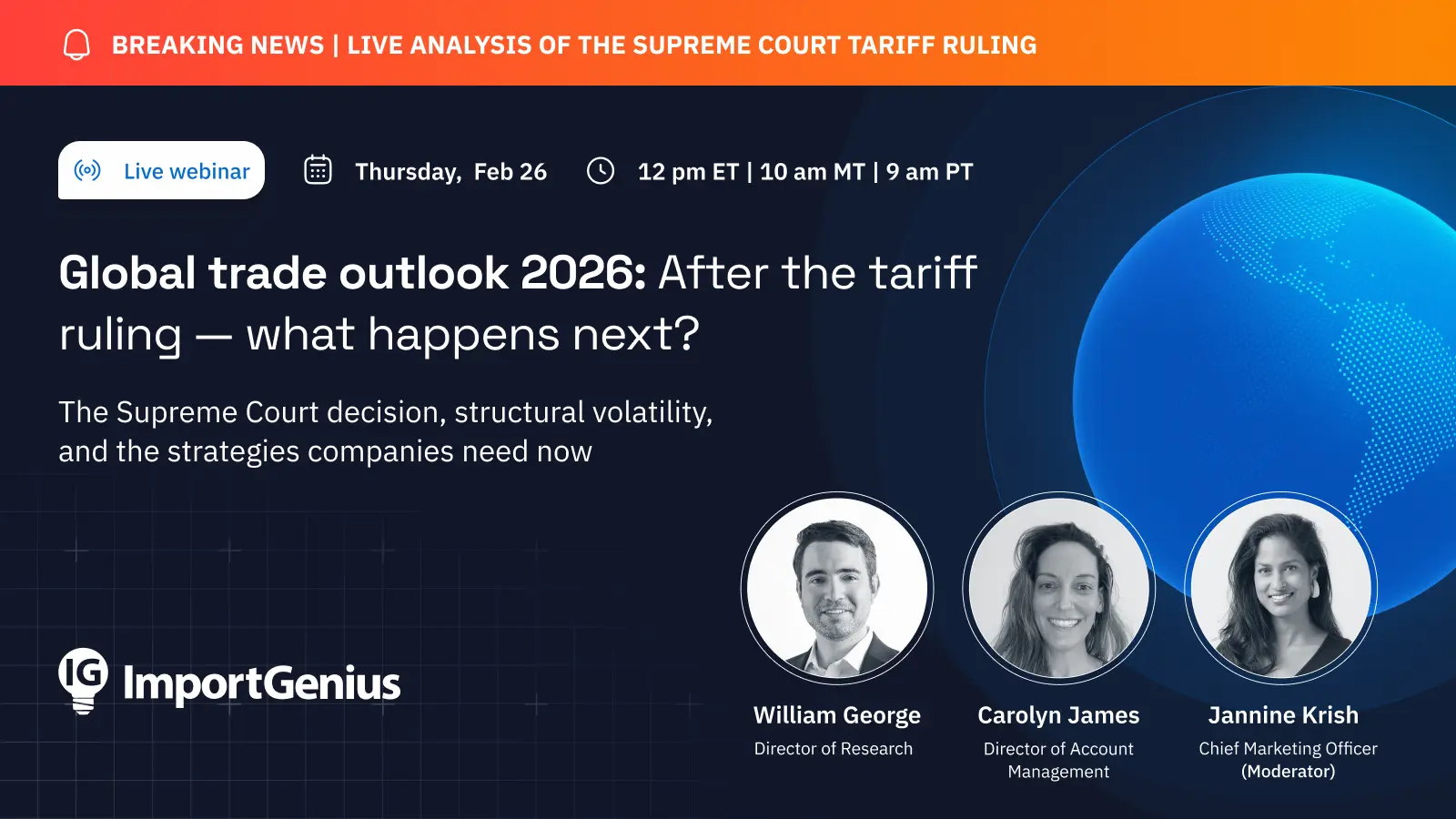
🔴 업데이트된 의제: 대법원 관세 판결 및 2026년 수입업자에게 미치는 영향에 대한 실시간 분석.
대법원 판결, 구조적 변동성, 기업이 현재 필요로 하는 전략
세계 무역 환경이 막 바뀌었습니다.다시 말씀드리죠.
미국 대법원은 국제비상경제권한법 (IEEPA) 에 따라 부과된 주요 관세를 파기하는 획기적인 판결을 내렸습니다. 이 판결은 2026년에 수입업체의 비용, 환불 청구, 조달 전략 및 경쟁 동력을 재편할 수 있는 판결입니다.
이것은 안정으로 돌아가는 것이 아닙니다.이는 관세와 지정학뿐만 아니라 법적 반전, 정책 전환, 글로벌 시장 전반의 권력 분열에 의해 주도되는 무역 변동성이 현재 구조적으로 변하고 있다는 것을 보여주는 가장 최근의 신호입니다.
라이브 브리핑에 참여하여 규정이 어떻게 바뀌고 무엇이 바뀌지 않는지, 지속적인 혼란으로 정의되는 한 해 동안 공급망 리더가 어떻게 대응해야 하는지 알아보세요.
다룰 내용
- 관세율 및 잠재적 환급 청구에 대한 대법원 판결의 실제 영향
- 과거 및 미래의 관세 변동성에 대한 노출을 평가하는 방법
- 7월 USMCA 검토에서 기대할 수 있는 사항
- 무역 세력이 분열되면서 미국 시장 점유율을 높이고 있는 국가는 어디입니까?
- 중국산 수입품이 현실적으로 대체될 수 있는지 여부와 이것이 전략적으로 의미하는 바
- AI와 무역 인텔리전스가 공급망 의사결정을 혁신하는 방법
또한 작년의 무역 전쟁이 실제로 선적량, 항만 활동, 공급업체 이동에 어떤 영향을 미쳤는지, 그리고 이러한 구조적 요인들이 향후 12개월 동안 어떤 영향을 미칠지 살펴볼 것입니다.
이것이 지금 중요한 이유
관세가 전복된다고 해서 변동성이 사라지는 것은 아닙니다.새로운 종류가 도입되었습니다.
- 법적 불확실성
- 잠재적 환불 소송
- 신속한 정책 반전
- 업계 전반의 경쟁적인 개편
누가 참석해야 하나요?
- 내년을 계획하는 비즈니스 리더
- 탄력성과 유연성을 추구하는 공급망 팀
- 치열해지는 경쟁을 헤쳐나가는 물류 경영진
- 소싱 전략을 재평가하는 소매업체 및 수입업체
- 공급업체 변화를 모니터링하는 마켓 인텔리전스 전문가
일부 회사는 상당한 자본을 회수할 수 있습니다.다른 무역 당국에서는 새로운 비용 압력이 가중될 수도 있습니다.
2026년에 승리하는 기업은 헤드라인에 반응하는 기업이 아니라 실시간으로 기초 거래 데이터를 읽는 기업이 될 것입니다.
👉 무역 인텔리전스가 글로벌 시장에서 가장 신뢰할 수 있는 선행지표가 되고 있는 이유를 알아보세요.
주요 패널:




2026 세계 무역 전망: 관세 판결 이후, 다음은 어떻게 될까요?
주요 패널:
스크립트
Jannine
Hello everybody. Welcome to our webinar 'Global Trade outlook 2026: after the tariff ruling - what happens next?’ We are just waiting for everyone to arrive and we will get started in a few minutes.
For those just joining, we're just going to give it another 30 seconds or so, and then we're going to get started with our webinar.
All right. Let's get started.
Okay, thank you, everybody, for joining us today. We see a lot of people coming in from all over the world. Canada, USA, China, Indonesia, India, uh, I see some from Latin America as well. Really, from all over, and I really appreciate you making the time to join us live.
Um, for this webinar, which was originally titled Global Trade Outlook 2026, where we were going to talk about our top 3 global trends that we're seeing based on our trade data at Import Genius. Then, of course, the Supreme Court landing. The Supreme Court ruling landed, and we pivoted our content slightly. So appreciate you still staying here. Uh, many of you have so many questions about this, and we're going to save 10 minutes at the end to answer all of your questions, and if we don't get back to you, please email me. You will hear from me right after this webinar. And I will make sure that you get your questions answered.
Um, so despite the ruling, our trends still hold true. Um… you'll all receive, actually, a copy of our Global Trade Outlook report, which is coming out next week, which actually goes into each of these 3 trends in more detail.
The first one being around structural volatility, which you're going to hear more about today. The second one is going to be around trade fragmentation versus the interdependence we're still seeing that our supply chain data reveals. And finally, we're going to briefly touch on the theme of intelligence-led supply chains, and how that actually is a competitive advantage for companies. So at the end of today, we're trying to get you to essentially see the forest from the trees or try to help with that, because there's a lot of murkiness happening that we're hearing about in the media, in boardrooms, across conversations with people at the dinner table, even.
But the three practical questions we want to help answer are what exactly is our exposure? How exposed are we? What… where is trade power actually shifting? And then what capabilities do I need as an importer or exporter now to compete in this landscape?
Now, before we dive in, I would like to take an opportunity to introduce our panelists. So let's start with William.
William
Thank you, Janine. Hi, I'm William George. I'm the director of research here at Import Genius, and I run our media, research, and statistical work.
Jannine
Thank you. And Carolyn.
Carolyn
Hi everyone, great to be here. My name is Carolyn James and I lead our account management and our strategic sales teams here at Import Genius, working directly with our clients and our prospects.
Jannine
Thank you so much for the quick intros. We also have James, who is currently not on screen. Feel free to give a little hi. We're going to go to him after. He's not part of the main panel, but we're going to ask him a question right at the end to touch on that third. Uh, more technology-related topic, as he's the Chief Product and Technology Officer here at Import Genius.
Okay, a little bit of housekeeping before we get started. We're going to spend about 30 to 35 min on our panel today. At the end of that, we will turn it over to you and give you the opportunity to ask questions.Also, everyone that is here today or who registered but didn't have a chance to attend will get the recording of today's webinar, which we'll send out tomorrow.
Okay, now let's get started on the question that everybody is asking. And this question is for you, William, to kick things off.What did the Supreme Court ruling actually change, and what did it not change?
William
Thank you, Janine. So this really is the question that's been on everybody's lips these past few days, because it was earth shaking. On one level, the Supreme Court ruling changed everything. The court's ruling this past Friday was the first time that the Supreme Court has come into direct confrontation, confrontation with the Trump administration over tariff issues, and it clearly established that there was no legal basis for all of the tariffs that Trump has levied under the Emergency Economic Powers Act. Now, a year after…After a year of uncertainty, we really have seen the rubber meet the road here, with the Supreme Court now exercising its constitutionally vested powers and stepping into regulate the executive. So this nullifies all liberation Day tariffs. It nullifies the previous 10% baseline global tariff and the trafficking tariffs imposed on China, Canada, and Mexico.
On another level, though, the fundamental constant of the past year in trade remains, and that is uncertainty and chaos.
The Supreme Court ruling did not provide a clear mechanism for companies to pursue tariff reimbursements. The closing of the de minimis exemption for personal purchases worth under $800 remains in effect, and Trump has doubled down on his commitment to pursue all possible avenues for keeping tariffs in effect. And his first move for maintaining those tariffs has been to threaten a new global rate. This was first 10%, then raised to 15% on Saturday, and now it's actually been imposed down back at 10%. And this is under the authority of Section 122 of the Trade Act of 1974. This is the tariff rate with the 150-day or 5-month limit that we've been hearing so much about, and this is the one that'll take us right up to the midterms.
It's possible that the White House will attempt to suspend and then reinstate the tariffs to restate the clock. This is a move which would undoubtedly be challenged by Congress as well as the court. But he has other mechanisms he can use. Section 301 tariffs, like those imposed on China during Trump's first term and Section 232 tariffs, these are the sectoral tariffs, the ones targeting steel, pharma, furniture. Those remain tools in the tariff arsenal, but they do require lengthy and documented investigative procedures before they can be implemented, which is critical because it gives supply chains and companies time to prepare. Where this leaves us now, though, is in turmoil. Companies are desperate to reclaim tariff refunds. Consumers who've been bearing the burden of increased prices, estimated at $1,700 a household, are wondering where their share will be. $175 billion have been collected but returning it will be far more complicated than the collecting process, which was actually no walk in the park either. And just this week, FedEx has already filed suit requesting a full refund, joining companies who've already filed and many who are sure to follow.
Jannine
Thanks, William. That gives us a sense of what's changed legally. And I know a few people have been following this very, very closely. Uh, let's move it to an operator's perspective, because the question that comes up is, like.
In this landscape where tariffs can be struck down at lightning bolt speed and then replaced within days, how are businesses supposed to actually plan?
William
So, speaking of the lightning bolt speed thing, that's been at core aspect of Trump's tariff policy so far, the sudden imposition and disappearance of tariffs. So in a certain way, the Supreme Court's definition ruling is actually a continuation of that. But at a higher level, I think businesses should understand that we're not out of the woods yet. So when Trump was campaigning, and as he was preparing to take office, he made it very clear that he was going to impose global 10 to 15% tariffs. When he actually began imposing tariffs his IEPA pronouncements were shocking to many supply chain practitioners because they were so far above what he'd campaigned on, especially the China rates. And the tariffs that were proposed then, which when he was campaigning, which we basically have right now these are still a significant tax on US businesses. So basically, we're back to November of 2024 situation in terms of tariff burden.
But companies were able to prepare by front-loading and warehousing in the hopes that they'd be able to bring enough goods in to prevent passing the prices of tariffs deeper into supply chains and on to consumers. Where we are now is that sort of the ideal end goal of front housing and front loading and warehousing.
Because the tariffs are illegal. But instead of celebration and a huge rush to get new goods in, though for some highly tariffed above 15% countries, we may still see that. We're now clearly just in it for the long haul. For the next 5 months, and quite possibly the remainder of Trump's term we're going to be at a 10 to 15% base tariff rate if he has anything to say about it. There are unlikely to be gaps in this or further front loading opportunities. If they appear, you should definitely take advantage of them, but expect to be paying 10% or more on all imports depending on sector.
Jannine
Hmm. Well, we've talked a lot about the legal mechanisms and forward risk. Let's now anchor this in actual evidence and turn it over to the data that we've been seeing. And the shifts in import volumes in 2025. Can you tell us a little bit about how companies that are based on our data, um, how they reacted to tariff uncertainty?
William
Yeah, certainly, and I'm going to do that by sharing a slide here, which is actually taken directly from the, the material that we're providing to you at the end of this webinar. So 2026 is just beginning, and it is already shaping up to be a distinctly different year in trade from 2025.
But 2025 is still the ideal year to look back on to explore how companies, ports and various trade lens were affected by deep tariff uncertainty. So in that way, 2025 is still our best guide because this is unprecedented in US history.
So, something to take into account is how dynamic companies are able to be when they are provided with room to maneuver. And we can see that very clearly here in this year-over-year USTU import data. So you'll notice the front-loading spike in January and February, that surge in the line. That was the result of bulk orders that were placed immediately after Trump won in November of 24. I mean, that's that's a three month, three and a half month amount of time between getting the information and rapidly responding and committing significant capital to front-loading. So companies really are able to scramble when they have to, and there's a lot of flexibility there. They just have to provide it with the opportunity to do so. And we see this also in the summer, where LA and Long Beach hit all-time highs, and that was so significant that you can actually see it in the spike during the summer of 25 here on the chart. That was also companies reacting, this time to the sort of opening in the clouds on tariff rates on China, where they were lowered from prohibitive to possible.
The benefit of working with U.S. Maritime trade data is that we can really see this happening in real time with daily TEU volumes visible. It was clear within a week that LA and Long Beach were headed for a record summer.
That inbound freight is already on the water, so there's not much hope when it comes to rerouting around the ports from a carrier perspective or a freight forwarder perspective. But if you're handling inbound container logistics after the ports. Uh, maybe you're in trucking, you're in rail, or you're in third party deconsolidation. At that point, you have another early indicator to ramp up operations for the next month or two.
Jannine
Thank you. So we can see how companies reacted when they had the room to maneuver. But a lot of teams aren't actually looking at TEU charts that often.
Um, they're stuck in the day-to-day operations of trying to forecast, price and plan in real time. So let's take an operational shift here, and I'm going to pose a question to you, Carolyn.
Um, how should companies rethink forecasting when cost structures can change mid-cycle?
Carolyn
Well, you know, Williams touched on some of the changes that companies have been able to achieve, things like stockpiling some shifts in countries of origin. But the reality is the past year has really shown us that supply chains are not that flexible, and they're in many ways very fixed.
Despite the efforts of the Trump administration to, one, reduce U.S. Dependence on foreign imports and two, reshore manufacturing, neither of those have really come to pass. And in fact, what we've seen is the trade deficit in physical goods has reached a record high.
Although, again, the tariffs did lead to some shifts in which countries were trading with the US. It did not reduce the total US imports of these physical goods. And on reshoring, we continue to see job losses, not job growth in the manufacturing sector, to the tune of 80,000 jobs lost in 2025.
On reshoring, we've also been reminded by business leaders and foreign leaders alike, brokering deals with Trump, that while they can make commitments to reshore and invest, these projects take years to come online and are riddled with challenges from obtaining necessary permits for construction to local resistance, to a lack of skilled US labor to employ at these factories.
Other reasons for caution if you look at the demand side, the US Economy continues to grow, and consumption continues to increase. But we are seeing signs of weakening demand that come with a K-shaped economy, something that's been a bit of buzz in the news lately. The idea of the K-shaped economy being that one segment of the economy grows. In this case, high income earners due to stock market gains and asset inflation, while the other side declines with stagnating wages, high housing costs, and inflation of consumer goods, including staple items that are reducing the spending power of the lower and the middle class.This is yet another reason for businesses to have caution.
And lastly, I'll point out that we see the same outsized performance by a select few in our stock market as well. While the stock market, again, has grown and made incredible gains in 2025, touted by the Trump administration, nearly all of these gains are in AI and big tech. Just seven stocks, the Magnificent Seven. And again, to put this in context, when the S&P 500 broke 6,900, a record high for the first time in 2025, nearly 80% of the stocks in the S&P 500 actually closed down and in the red on that very same day.
The point being that you know this this success is not spread evenly across the industries, and industries that are affected by tariffs and inflation have taken really big hits. Consumer staples sector in particular has underperformed in the market. These games belong to just a few. So what does this mean for business? Business that isn't tech or AI? Well, short of trying to capitalize on AI excitement and maybe adding .ai to your company name in hopes of raising your stock price, the thing is really to stay steady and cautious. The winners are survivors. Those that have strong balance sheets and can best mitigate uncertainty and increasing costs. The big companies that have the cash and the ear of administration are most likely to survive.
Jannine
Hmm. So not everyone is feeling the brunt of this equally as we know.Question, William, does it still make sense to get ahead of tariffs by preemptively or by by pre-importing and stockpiling?
William
No, so pre-importing and stockpiling is over. There's one exception, though, and that would be if you are in an industry that is impacted by current or future Section 232 investigations. That connects back to my first point, where if you know that you're about to have your sector slammed with uncertain new tariff rates, you won't know what the rates are, but you know that they're coming that is the time to start bringing goods in. This is going to be a lot less dramatic in terms of overall logistical impact, though, because it's so segmented. So we'll see a much lower logistical footprint and impact with the port chaos that we've seen previously, because it's sector by sector.
Also, industries like pharmaceuticals are very reliant on air freight. So that will also ease the burden a lot when it comes to ports like LA and Long Beach, which could otherwise be clogged with Chinese furniture imports or large bulk goods coming in from Southeast Asia. So there's going to be a lot less stress on that maritime port infrastructure when sectors begin to stockpile.
Jannine
Okay, so stockpiling isn't the answer. Let's bring this back to execution.What are… this one is for Carolyn. What are the… what's the biggest mistakes that companies are currently making?
Carolyn
I mean, it's really tough out there right now for companies. I think the biggest mistake a company can make right now is just not being informed, which is a tall order these days. It's really critical to stay on top of news, market conditions, your own supply chain and data. Complexity has increased tremendously, whether that is staying on top of all of these tariff changes and political news. Staying on top of deadlines to file for refunds and lawsuits and keeping up with these changes all require resources and add a burden to small businesses in particular.
Something to think about also is that companies may need to bring in additional resources to address these challenges. This is going to be the refunds in particular are going to be as cumbersome a process as possible, and deadlines are likely to be important. The amount of paperwork and processing is likely to be outside of the scope of normal business, so I would really urge everyone to make sure you have a good handle on what kind of resources you will need. And be able to plan accordingly.
William
One quick additional point there is, you could. You could estimate your potential tariff refund, and then look to some fraction of that to staff additional headcount for accounting or tariff refund processing.
Jannine
That's a good point. Thank you. Now we've talked a lot about what companies should be doing. I do want to take a moment to turn it over to audience to see what's happening. So I have a quick poll for you, which I'm just going to launch in a second. There we go. You should see it now. Has the recent tariff ruling prompted your organization to reassess sourcing or pricing strategies?Would love to hear your thoughts on this, or to get your thoughts on this. Still seeing some answers coming in. I'm going to share the results. So please take a moment.Okay. Let's share the results so far, bit of everything. Thanks for taking the time. That's helpful context.
Uh, let's zoom out. I'm going to stop sharing that. The ruling disrupted tariff mechanics. And it didn't change global production realities, however. So William, let's get into the nitty-gritty of maritime data and talk about China's share decline. What does it not show? What does it show?
William
Sure thing. I'm gonna go back to the material that we're going to be sharing here. One more slide for you all little sneak peek. And also, I'm glad to see the results of the poll that so many people are focused on this and actively monitoring the situation. So this, this table here is an indication of what we've seen through a TU-based analysis of US maritime trade imports. And this is looking at all US global trade and the share of that trade that different companies have countries have held year over year, 24 to 25. And if we look at this, we can see that in the past year alone, China's share of global US imports has dropped roughly 4%. And that amounts to a little over a million TUs, which if you think about that in terms of vessel capacity. That's a lot of boats. So, if you look at the data for the other countries in the region, you can see directly below China here, in the teal, we have Vietnam, India, and Thailand. Those are all stepping up to fill in the gap that has been left by trade rerouting around China. It's important, though, to note that this is going to be maritime only, so it does not account for the vast majority of Chinese e-tailer activity like Shein or Timu, who are moving goods in. Largely by air freight, though we have noticed a number of Temu imports via maritime under various, various different corporate identities. But China's share of US maritime imports is clearly declining, and this is a continuation of a year over year trend. Though the tariffs have clearly accelerated this and had an impact.
To me, though, the real question here is how much of this actually indicates a shift of productive capacity out of China and into these trading partners, into Vietnam, into India or Thailand. This recent ruling with the Supreme Court shows that there are tremendous risks associated with the investment of significant capital and time into building out new manufacturing capacity in order to align with what is a mercurial and legally questionable U.S. Trade policy.
Something else that we noticed is that the average dollar value of a given TEU imported into the US from China has dropped dramatically. In fact, it's fallen around 40% from December to the summer of this year, which is how far our analysis is extended. Which is staggering about $30,000 to around $17,000. We're getting more precise figures on that.
While part of this may be due to the lower dollar impact of tariffs on cheaper goods, the lower perceived cost. There is another factor of this which has been reported by Bloomberg, both in the summer and also a couple of days ago, 2 days ago, and that's the rise of Chinese logistics companies who are working their ways towards fraudulently declaring values in order to find an unfair way to compete with customers and competitors who are actually paying the tariffs. Because if you imagine that the Chinese shipper receives the full value of the goods, declares to customs a lower value, and then their customer pays a lower value of tariff. That effectively allows them to sell their goods at a lower cost to consumer than those who are engaging in trade under fair practices.
And while this does lower the tariff burden for those customers, it raises a lot of questions about tariff refunds. Will there be an extra level of scrutiny applied now that there's a second chance to catch fraud? I think that's quite likely, and this could also have a chilling effect on the Tariff Refund activity that the Trump administration is maybe counting on to suppress refund claims.
To zoom over across from the Pacific to the Atlantic, though, if we look at Europe, which has had its own bout of tariff whiplash recently with the Greenland discussion, Europe is quite likely to benefit from the confiscation of Trump's IEPA powers. But with a highly advanced manufacturing economy, they're ripe targets for Section 232 sectoral tariffs, and will be substantially impacted by almost any implementation of the proposed pharma tariffs when that investigation concludes. That easily impacts over $115 billion dollars a year of trade between the US and Europe, and will also likely have a knock-on effect on US healthcare costs.
So if we look at the recent US Customs trade statistics calculated by value overall US Imports of goods from China are down about 30% year over year. US exports to China fell as well when China retaliated against the Trump admin's policies. And this is particularly visible in the agriculture sector. But even giving this, the US trade goods deficit fell to $202 billion. This is while still an enormous number, the smallest it's been in over 20 years, and the first time ever that we've had a smaller deficit with China than with the EU.
But I'm looking at these numbers, and I'm looking at the TU thing, and I'm thinking that there's a puzzle here that's sticking in my mind. So when we look at the drop in US imports from China of maritime T use, which is 1.1 million again, in contrast, with the drop in dollars of US containerized maritime import value from China, which is down roughly 27% in that precise category, it just doesn't seem like these things are tracking. And… considering the precipitous drop in TU value, there's a picture emerging here which raises serious questions about the actual accuracy of the data that Customs is collecting and reporting as far as the trade value in dollars is concerned concerned. It seems like with the tariffs we've actually created perverse incentives against correctly reporting trade to customs, and these may have resulted in a substantial undervaluing of our actual trade with China. So we should be taking the recent GDP figures with a bit of a grain of salt as more investigations happen here and Bloomberg two days ago reported that potentially $150 billion more trade from China to the US entered the US than has been actually reported and factored into the US's numbers. So we're going to have to have a lot more investigation here because this impacts air freight just as much as maritime. We may be seeing substantial swing and adjustment of our most serious top-level financial figures.
Jannine
That's a staggering number, and really what you've said, you know, enlightens us on the the risk that we're really misreading the scale of this change.
Let's widen the lens for a moment. Even with the tariffs and with the ruling, China, we all know, remains central to global manufacturing.So Carolyn, I'd like to turn it over to you around this topic. So, with the new order in place, what is really the net impact for China? And before you answer that, I just want to remind everybody to pop your questions in the Q&A, and we're going to get to them in about 10 10 minutes or so.
Carolyn
Yeah, I mean, I think it's even with what William's saying around maybe the US is still actually importing a lot of things from China, it's no surprise China remains a manufacturing powerhouse. It has for decades with excess capacity. It also struggles with weak domestic consumption, a real estate bubble, weak currency, where foreign imports are relatively more expensive for Chinese consumers. And, you know, despite Trump's tariffs and the US attempt to pull away from China, China has continued to dramatically increase its trade surplus away from the United States to other countries. But again, to put numbers around this, in 2025, China's trade surplus grew to $1.2 trillion. The largest trade surplus on record. No other country has had a larger surplus in modern history.
And again, to put some context around this, China's current trade surplus is five times what Japan's trade surplus was with the world in the 1980s in today's dollars. And at the time, in the 80s, that surplus with Japan caused a huge amount of panic in the US, and this is literally five times that size. So, uh, it's really quite staggering, and I think it really points to the fact that China will continue to find foreign buyers and make foreign investments along the Silk Road and other places, because it really needs the export market to prop up its economy. However little or however much the US is going to play a role in that.
Jannine
Yes, it's pretty clear. China is going to keep exporting no matter what. What does the specter of trade deals without the US mean for the future?
Carolyn
Yeah, I mean, we've seen a lot of activity in trade with China and with other countries. The fallout of sort of the instability of the United States and the more…uh… combative approach we've taken to global trade. We've seen companies, or countries, rather, make deals. Um, China recently updated and expanded the China ASEAN Free Trade Area, or CAFTA, in October 2025, further expanding trade there. Um, just in January, we've seen China and Canada finalize a trade deal that cuts tariffs on EVs and canola oil and also probably most notably India and the EU signed a free trade deal in January of 2026, a deal that covers nearly 2 billion people and slashes tariffs between those countries.
All that being said, though the US isn't really making many deals, it is certainly doing business and doing a lot of trade. So despite the tariffs, the US trade deficit in goods has hit a record high. and the US continues to import more than it ever has from all over the world.
William
Yeah, and the idea that has sort of underpinned this tariff policy is the idea of reshoring and bringing back everything under American business. So everything from extraction to manufacturing, basically a full vertical reintegration of the US and while these things take time, we're clearly not rebuilding on this capacity. We're investing in rare earth mining, which is an important step, but that's going to take many years to pay off dividends, and we are not effectively ramping up any significant industry, uh, or doing much building in the country at the moment, aside from a massive buildout of AI data center infrastructure. So we'll need to see a lot of movement before we could potentially benefit from .. for American manufacturing. And even setting aside the fact that we're not currently building out this capacity. There's also no way that these goods will ever be price competitive with the Chinese or Southeast Asian manufacturing prices that over the past 20 years US consumers have come to know and love. For example, a couple months ago, Wedbush analyst Dan Ives made a lot of waves with a calculation that a 100% made in America iPhone would cost around $3,500. And this would not be an isolated issue. This would extend to similar cheap staples like televisions and refrigerators, which would likely 3 to 4x in price. So we might have a return to the idea of the refrigerator as a status symbol in our future.
Jannine
That's a scary thought. If imports from China can't be fully replaced, Carolyn, what should companies realistically be doing?
Carolyn
Well, you know, again, I think the point here is China is a manufacturing powerhouse. It's continuing to do a lot of business around the world and with the US and on the side of the US, You know the US is the world's largest consumer market in terms of spending power. And there really is no evidence despite a lot of intent from the Trump administration to sort of change the dynamics. The rest of the world can't really fill the gap in manufacturing or the gap in spending, which inevitably entries the US and China together.
And the point I think to really make of the last year is that these trade wars have really hurt the people and the businesses of these countries, China and the US. Recently, the New York Times reported on the duality we see in Ningbo, China, which is the world's busiest container port and a city with a population of nearly 10 million people. All exports continue to hum, margins have collapsed on these exports. Automation has taken over jobs to combat these falling margins. There's been falling asset prices, particularly in the asset, uh, in the housing market. That's really destroyed middle class wealth and eaten into consumer spending power. Unemployment is high, government spending, which is reliant on real estate prices, has collapsed. And the domestic activity in this very, very busy halt has basically ground to a halt.
In the US, you know, we also see suffering. American companies and consumers have footed the bill for these tariffs, and we see some of our sectors have taken really big hits, most notably American farmers. Um, and those who sold soybeans to China. Again, to put some numbers around this, the USDA Foreign Agricultural Service shows a 76% drop in bulk soybean exports to China. That is trade that went from 12.6 billion dollars in 2024 to just 1.3 billion in 2025.
On top of this, the USDA is projecting that the 2025 soybean crop will be the most expensive soybean crop ever grown on a per acre basis, leaving soybean farmers with their third straight year of significant losses. We're seeing the effect of this. US farm bankruptcies have spiked by 46% in 2025, and we expect that we're going to continue to see these bankruptcies due to high prices and a lack of foreign buyers.
The point in all of this being that these tariffs really have been punishing to many people and businesses in both countries, and the US and China really will have to continue to figure out how to work together.
William
And just to quickly follow up on that point, if we look at American farming, we can see that, though it doesn't seem like it as almost an import export business, because they're hit by tariffs on both ends. All of their inputs, machinery, fertilizer, everything they're using to plant and maintain their fields, that's getting more expensive. And on the other side, they're also having a harder time selling their crop. So they're really caught in the crosshairs here in an awful way.
Carolyn
네, 윌리엄, 정말 좋은 지적입니다.
재닌
음. 우리가 논의했던 상호 의존성으로 다시 돌아가 보면요. 압박이 사라지지 않는다는 것을 알 수 있습니다. 가장 즉각적인 압박 지점 중 하나는 북미 지역입니다. 윌리엄, 다가오는 USMCA 검토에서 무엇을 기대해야 할까요?
윌리엄
USMCA 검토는 트럼프가 북미 무역에 대한 자신의 새로운 비전을 주장할 기회가 될 것입니다. 그리고 트럼프가 2019년에 NAFTA(그는 이를 매우 나쁜 무역 협정이라고 특징지었습니다)의 업데이트로 USMCA를 제안했다는 사실에는 상당한 아이러니가 있습니다. 트럼프는 이제 자신이 멕시코와 캐나다에 부과하고 싶어 하는 관세를 부과하는 데 있어 자신의 무역 협정인 USMCA에 의해 저지당하고 있습니다. 따라서 여기서 주목해야 할 점은 트럼프가 우리의 가장 가까운 두 무역 파트너에게 광범위하게 관세를 부과할 자유를 허용하는 재구성되거나 완전히 차단된 협정이 될 것이라고 생각합니다. 그 122조항에 따라 트럼프의 가변 관세율을 신속하게 부과할 수 있는 능력이 제한되었죠? 그리고 그것이 그가 위협했던 15%가 아닌 10%만 부과할 예정이었다는 것을 우리가 알게 된 이유 중 하나입니다. IEPA 권한이 그에게서 박탈되기 전에 그가 외국 무역 파트너들과 맺은 무역 협정에 의해 최대 10%의 글로벌 세율에 묶여 있었기 때문입니다.
따라서 그는 이제 일관성 없는 세율을 부과할 수 있게 해주었던 관세 부과에서의 운영 유연성을 잃었기 때문에 초점을 좁혀야 할 것입니다. 그는 이제 대체 도구를 사용해야 하므로 초점 범위가 좁아질 것입니다. 일부는 아직 테스트되지 않았고, 일부는 긴 조사 과정이 필요합니다. 그는 아마도 중국, 멕시코, 캐나다에 집중할 것입니다. 이들 국가는 이전에 그의 관세의 초점이었고, 지난 한 해 동안 그의 수사와 활동 면에서 가장 공격적으로 단속해 온 국가들입니다.
재닌
분명히 앞으로 더 많은 혼란이 있을 것입니다. 하지만 환경에는 위험도 따릅니다. 위험은 이겁니다. 음, 우리가 보았듯이 기업들은 과잉 반응할 수도 있고, 과소 반응할 수도 있습니다. 윌리엄, 소싱 결정을 과도하게 변경하는 것의 위험은 무엇일까요?
윌리엄
캐롤린이 앞서 지적했듯이, 중요한 발견 중 하나는 공급망이 매우 유연하지 않다는 것입니다. 따라서 가장 중요한 교훈은 가능한 최선의 해결책이 아니라 작동하는 것에 집중해야 한다는 것입니다. 필요한 물량을 처리할 수 있고 경쟁력을 유지할 수 있는 공급망을 가지고 있다면, 그것은 환상적입니다. 상황이 안정되기를 바라는 몇 년 후에는 정말 좋은 위치에 있게 될 것이며, 그때 개선 사항을 구현하기 시작할 수 있고, 지금부터 그러한 개선 사항을 고려할 시간을 가질 수 있습니다.
하지만 현재로서는, 그리고 앞으로 1, 2년 동안은 충분히 좋은 것이 훌륭하다는 점을 명심해야 한다고 생각합니다.
재닌
그 인용구가 마음에 드네요. 충분히 좋은 것이 훌륭하다. 하지만 '충분히 좋은 것'이 실제로 무엇인지 알 수 있는 가시성이 있을 때만 그렇다고 덧붙이고 싶습니다. 이것이 다음 설문조사로 이어집니다. 청중 여러분의 의견을 듣고 싶습니다. 잠시만요. 이제 모두 보이시죠? 그렇다면 비용이나 가용성에 영향을 미치기 전에 공급망 위험을 감지하는 능력에 얼마나 자신 있으십니까? 잠시 시간을 내어 질문에 답변해 주시면 감사하겠습니다.
좋습니다. 설문조사를 종료하고 결과를 공유하겠습니다.
음, 여전히 반응적으로 운영되는 기업들이 분명히 있습니다. 이것이 바로 우리가 인텔리전스 기반 공급망의 부상을 목격하는 이유입니다. 이제 시간이 거의 다 되었다는 것을 압니다. 하지만 제임스, 마무리 질문을 위해 Q&A로 넘어가기 전에 카메라를 켜주세요. 음, 무역 관점뿐만 아니라 기술 및 역량 관점에서도 이와 관련된 질문을 드리고 싶었습니다. 처음에 듣지 못하신 분들을 위해 말씀드리자면, 제임스는 Import Genius의 최고 제품 및 기술 책임자이며, AI, 무역 인텔리전스, 공급망 의사 결정의 교차점에서 우리의 업무를 이끌어 왔습니다. 제임스, 마지막 질문을 위해 함께 해주셔서 감사합니다. 네.
제임스
물론이죠, 재닌. 감사합니다. 큰 질문이네요. 제가 이 웨비나에 참여하면서, 꽤 큰 주제를 요약하기 위해 몇 가지 생각을 빠르게 정리해 보았습니다만... 구조적으로, 저희 사용자들에게 큰 변화는 시간 범위라고 생각합니다. 변동성이 커진다는 것은 우리가 거시적인 연간 전략 계획, 일상적인 현상 유지 운영이라는 스펙트럼의 한쪽 끝에서, 워룸 스타일의 빠른 의사 결정에 더 가까운 다른 쪽 끝으로 이동하고 있다는 것을 의미합니다. 그리고 이러한 산업의 움직임은 마치 물고기 떼처럼, 변화하는 상황에 반응하여 이리저리 빠르게 움직이는 것과 같아지고 있습니다. 적어도 실행에 유연성이 있는 한도 내에서는 말이죠. 캐롤린이 언급했듯이, 공급망은 전체적으로 그렇게 민첩하지 않습니다. 오늘 첫 번째 설문조사에서 참석자의 30%가 상당한 전략적 조정을 했다는 것을 보았습니다. 그리고 나머지는 뒤처지고 있죠? 극적인 움직임을 할 준비가 안 되어 있습니다. 할 수 없습니다. 그리고 이 모든 것이 데이터와 도구에 대한 새로운 요구를 만들어냅니다. Import Genius의 제품 책임자로서, 저희 고객들이 이전보다 데이터의 신선도에 더 많은 관심을 가지고 있다는 것을 알게 되었습니다. 매일 업데이트될 수 있는 데이터 소스는 이러한 환경에서 더욱 가치 있게 될 수 있습니다. 그리고 도구 측면에서는, 이는 분석을 수행하고 통찰력을 더 빠르게 찾을 수 있는 능력을 의미합니다.
따라서 저희와 같은 기성 제품이 강력하고 사용자 친화적인 분석 접근을 제공하는 만큼, 새로운 AI 도구는 복잡한 임시 분석을 실행할 수 있는 능력도 제공합니다. 예를 들어, 저희 Import Genius 제품에 들어가서 항구에 집중하거나 원산지별로 분류하거나 TEU별로 세분화하는 것과 같은 분석 보기를 빠르게 만들 수 있습니다. 그리고 이것은 빠르고, 매우 실용적이며, 매우 유용하고 생산적일 수 있습니다. 하지만 그때 저는 제 상황, 제 산업, 제 사업에 미묘하고 특정한 것에 대해 일반적인 데이터 도구가 만들어지지 않은 종류의 더 구체적인 질문을 가질 수 있습니다. 이것이 Import Genius의 연구 부서가 종종 다루는 분석 과제들입니다.
하지만 이 수준은 사내에 데이터 분석가가 없다고 가정할 때입니다. 새로운 AI 도구에 익숙해지시기를 강력히 권합니다. Anthropic Pro 구독을 하고, 제가 아는 가장 사용자 친화적인 최첨단 도구인 Claude Cowork를 설치하세요. 새로운 Opus 4.6 모델을 사용하고, Import Genius 또는 다른 데이터 소스에서 10,000행 쿼리를 내보낸 다음, 특히 이러한 역량이 없는 회사들을 위해 어려운 질문을 찾아내도록 지시하세요.
이 새로운 모델들이 무엇을 할 수 있는지, 그리고 몇 분 안에 대화형 결과를 만들어내는 것에 놀라실 것이라고 생각합니다. 이미 시도해 보셨더라도, 기술은 1월에만 해도 크게 발전했습니다. 그리고 그 기능들은 계속해서 가속화되고 있습니다. 이 주제에 익숙하지 않은 분들을 위한 저의 추가 조언은 AI 기능을 자랑하는 기성 분석 패키지를 구매하려는 충동을 억제하고, 대신 Anthropic의 Claude Opus 또는 OpenAI의 새로운 코덱과 같은 최첨단 모델과 직접 작업하는 것입니다. 최근 기술과 현재 최첨단 기술 간의 격차는 엄청나며, 특히 지난 12개월 동안 그러했습니다. 따라서 새로운 기능이 출시될 때 바로 그 시작점에 있어야 합니다. Databricks나 Snowflake와 같은 최첨단 공급업체조차도 BI 기능에서는 이 단계에서 필연적으로 뒤처집니다.
오늘 제가 드릴 조언은 여기까지입니다. 도움이 되셨기를 바랍니다.
재닌
제임스 씨, 정말 감사합니다. 오늘 많은 청취자분들께 큰 도움이 되었을 것이라고 확신합니다. 질문이 많이 들어왔는데요, 스티브 씨의 질문부터 시작하겠습니다. 멕시코와 캐나다에서 미국으로 들어오는 무역 데이터에 대해 묻고 있습니다. 이 수치들은 어떤가요? Import Genius는 해상 데이터만 사용하나요? 이 질문은 여러분 중 누구라도 답할 수 있을 것 같으니, 제가 여러분께 여쭤보겠습니다.
윌리엄
네, 제가 먼저 말씀드리겠습니다. 미국에 대해서는 해상 수입 데이터만 접근할 수 있지만, 멕시코의 경우 모든 운송 수단을 포괄하는 훌륭한 데이터에 접근할 수 있습니다. 이 데이터는 매우 상세하며, 수출입 활동을 통한 부가가치, 상품의 제조 변경 사항 등도 파악할 수 있게 해줍니다. 따라서 저희가 여기서 작업해 온 것에 대해 많은 것을 할 수 있습니다. 저희 연구 부서에서는 글로벌 무역 전망 통계를 취합하면서 미국 해상 무역 활동에 주로 집중해 왔습니다. 하지만 저희는 다른 국가의 데이터도 자주 다루며, 이에 대해 기꺼이 논의하거나 조언해 드릴 수 있습니다. 또한 멕시코 무역 데이터의 많은 장점에 대해서도 자세히 말씀드릴 수 있습니다. 이 데이터를 지난 1년 반 정도 동안 확보했으며, 이에 대해 매우 기대하고 있습니다.
안타깝게도 캐나다는 데이터를 공개하지 않습니다. 하지만 캐나다로 가는 도중에 미국 선박을 경유하거나 미국에 정박하는 선박에 실린 캐나다 해상 수입품의 일부는 여전히 확인할 수 있습니다. 선상에 남아있는 화물은 신고되기 때문입니다. 예를 들어, 밴쿠버의 많은 수입품을 볼 수 있습니다.
감사합니다.
캐롤린
네, 덧붙여 말씀드리자면, Import Genius가 사용자에게 제공하는 데이터는 매우 세분화되어 있으며 실제 거래 기반 데이터입니다. 이는 미국 해상 데이터와 멕시코 무역 데이터입니다. 또한 중요한 점은, 저희가 글로벌 무역 전망 보고서와 이번 웹 세미나에서 이러한 통계들을 여러 번 언급했다는 것입니다. 공개적으로 이용 가능한 데이터도 있습니다. 이는 미국 인구조사국 데이터로, 전반적인 글로벌 무역을 설명하고 멕시코와 캐나다 무역에 대해 상세히 다루지만, 선하증권(bill of lading) 수준은 아닙니다. 따라서 그러한 가시성을 확인할 수 있으며, 그 중 일부는 오늘 이 웹 세미나에서 언급되었고, 글로벌 무역 전망 보고서에도 언급되어 있습니다.
윌리엄
맞습니다. 이 세분화된 데이터의 장점은 최상위 통계 데이터에서 확대하여 어떤 특정 기업이 어떤 부문에서 어느 정도 영향을 받는지 파악할 수 있다는 것입니다.
재닌
다음 질문입니다. 마이크 씨의 질문입니다. 관세 환급에 대한 이야기가 왜 그렇게 복잡하다고 하는 건가요? 저희는 대부분의 회사들처럼 모든 CBP(세관국경보호국) 신고를 관세 범주별로 기록하고 있습니다. 그래서 대법원 판결이 났을 때, 신고 건별 환급 번호를 받는 데 말 그대로 15분밖에 걸리지 않았습니다. 며칠 내로 모든 정보를 연방 정부에 제공할 수 있었습니다.
윌리엄
이상적인 환경에서는 말씀하신 것처럼 빠르고 쉬운 절차가 될 것입니다. 하지만 지난 금요일 트럼프 대통령의 발표를 보면, 그는 처음에는 이것이 수년간 법정에서 다뤄질 것이라고 말했고, 나중에는 5년이라고 수정했습니다. 그리고 그가 이 일을 더 어렵게 만들 수 있는 몇 가지 방법이 있습니다. 우선, 트럼프 행정부는 이 1,750억 달러를 돌려주지 않을 강력한 동기를 가지고 있습니다. 그래서 그들은 이 과정을 늦추고 막기 위한 어떤 구실이라도 찾고 있으며, 이미 검토할 것이라고 밝힌 한 가지 방법은 기업들이 관세 부담을 소비자에게 전가하지 않았다는 것을 증명하도록 하는 것입니다. 즉, 기업들이 관세에 따라 가격을 인상하여 가상적으로 이익을 얻고, 동시에 관세 환급까지 받을 수 있다는 생각인데… 이는 합리적인 주장일 수 있지만, 일을 지연시킬 것입니다.
재닌
감사합니다. 매우 구체적인 질문이 많이 들어오고 있습니다. 아, 죄송합니다. 계속 말씀하세요.
캐롤린
죄송합니다. 여기에 덧붙여서 말씀드리자면, 윌리엄 씨가 이 웹 세미나 초반에 언급했던 잠재적인 사기 및 관세 미납 문제에 대해 말씀드리자면, 이 모든 것이 그 주장을 더욱 복잡하게 만들고 있으며, 상황이 잠재적으로 매우 빠르게 까다로워질 수 있다는 점을 시사합니다.
재닌
감사합니다. 저희도 매우 구체적인 관세 관련 질문들을 많이 받고 있습니다. Import Genius는 이 특정 분야의 전문가는 아니지만, 혹시 모르니 어디로 가야 할지 알려드리고 싶습니다.
윌리엄
특히 관세 환급을 말씀하시는 거죠? 저희는 관세사도 변호사도 아니니까요. 죄송합니다, 관세라고 말씀드렸지만, 특히 환급에 대해 말씀드린 겁니다.
재닌
그럼... 어디로 가야 할까요? 관세사나 변호사에게요?
윌리엄
캐롤린, 이 문제에 대해 뭔가 생각하고 계신 것 같던데요.
캐롤린
네, 제 생각에는 가장 좋은 방법은 관세사와 상담하는 것입니다. 아니면 사내에 관세 담당자가 있다면, 그분들이 바로 전문가가 될 것입니다. 무료 관세 계산기를 제공하는 회사들도 있고, ACE 포털에 접속하면 그러한 것들을 추정하는 데 도움이 될 수 있습니다. 하지만 정말로, 전문가와 상담해야 합니다. 그리고 그 전문가들은 바로 관세사들입니다.
재닌
정말 감사합니다. 시간이 정말 다 됐습니다. 사실 2분이나 초과했습니다. 그래서 제가 제안하는 것은 질문을 저에게 공유해 달라는 것입니다. 내일 녹화본을 받으실 텐데, 저희가 답변할 수 있는 질문이 있다면 직접 회신해 주시면 됩니다. 저희가 다시 연락드리겠습니다.
잠시 시간을 내고 싶었습니다. 아, 죄송합니다. 윌리엄에게 웨비나 초반에 나왔던 다른 질문 하나에 대해 이야기할 기회를 드리는 것을 잊었네요. 다시 돌아가겠습니다. 윌리엄, 338번 질문이요.
알겠습니다.
윌리엄
네, 이 질문은 청중 중 다니엘님이 해주셨습니다. 스무트-홀리법 338조가 122조 이후에 상황을 확대하는 데 사용될 수 있다는 생각은 충분히 가능하다고 봅니다. 트럼프의 관세 부과 전략에서 우리가 본 것이 있다면, 그는 상황을 확대하고 변곡점, 즉 위기 지점에 도달한 다음 축소하는 것을 좋아한다는 것입니다. 그리고 이것은 많은 관심을 불러일으키고, 미국 무역 파트너들로부터 많은 우려를 야기하며, 이는 잠재적으로 미국에 유리한 무역 협상으로 활용될 수 있습니다. 따라서 그런 일이 일어난다고 해도 전혀 놀랍지 않을 것입니다. 하지만 AEPA처럼, 이것은 전혀 시험되지 않은 권한이며, 사실상 의회로부터 대통령에게 위임된 권한입니다. 따라서 IPA가 이의 제기를 받았던 것처럼, 이것에 대해서도 많은 법적 이의 제기가 있을 수 있으며, 매우 유사한 주장이 제기될 수 있습니다.
하지만 여기서 가장 흥미로운 일종의 '최후의 수단'은 338조가 전면적인 무역 금수 조치로 이어질 수 있다는 것입니다. 트럼프는 금요일 연설에서 무역 금수 조치를 언급했으므로, 이것이 그의 마음에 있을 가능성이 높습니다.
재닌
정말 감사합니다. 이제 마지막 마무리 슬라이드로 돌아가겠습니다. 잠시 시간을 내어 참석해 주신 모든 분들과 존경하는 패널리스트 윌리엄, 캐롤린, 제임스께 감사드립니다. 이 행사를 준비하는 데 많은 노력이 들어갔다는 것을 알고 있습니다. 귀한 시간을 내주셔서 정말 감사합니다.
마지막으로, 더 궁금한 점이 있거나 저희 팀과 직접 이야기하고 싶은 분들을 위해, 저희는 많은 무역 전문가와 전문 인력을 보유하고 있습니다. 언제든지 저희와 상담 시간을 예약하세요. 저희 웹사이트 importgenius.com 상단에 있는 '데모 예약' 양식 아래에서 링크를 찾으실 수 있습니다.
그리고 오늘 참석하셨거나 등록하신 모든 분들께 저희의 '글로벌 무역 전망 2026'을 무료로 제공해 드릴 예정이라는 점을 다시 한번 알려드립니다. 다음 주에 공유될 예정이며, 저희 발표 내용의 상당 부분도 여기에서 발췌한 것입니다.
이제 마무리하며, 남은 한 주도 즐겁게 보내시길 바랍니다. 다시 한번 감사드립니다. 그럼 이만.
