

Secretos comerciales expuestos: cómo ver lo que importan, venden y abastecen sus competidores
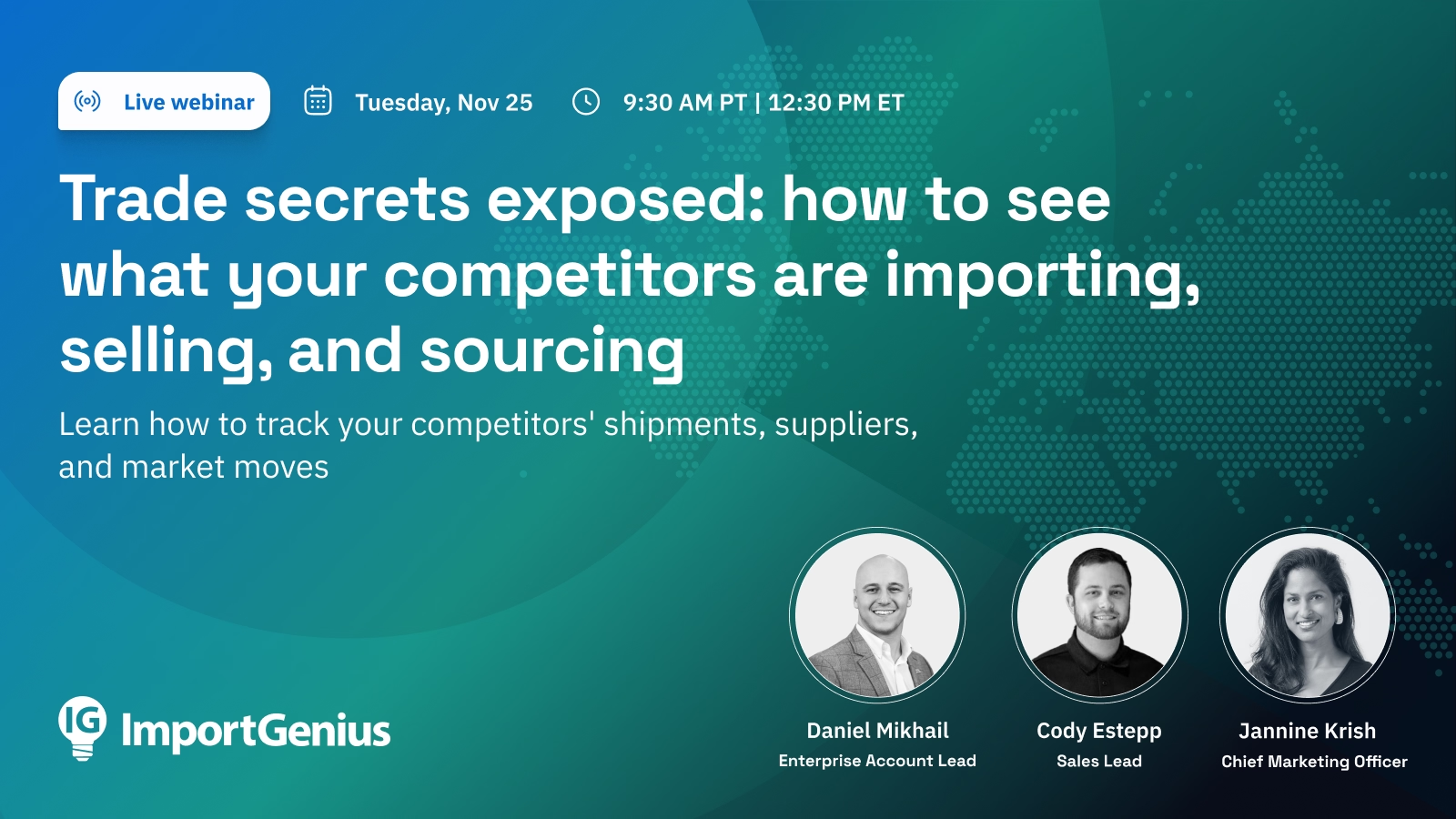
Secretos comerciales expuestos: cómo ver lo que importan, venden y abastecen sus competidores
Vea la grabación de nuestro seminario web para aprender a rastrear los envíos, los proveedores y los movimientos del mercado de su principal competidor.
Para quién es: Fabricantes, líderes de aprovisionamiento/compras, equipos de inteligencia de mercado, legales y de GTM.
Los movimientos globales de tus competidores son visibles si sabes dónde buscar. En esta sesión en vivo de 30 minutos, nuestro equipo demostrará cómo rastrear los envíos, los proveedores y la expansión del mercado de los rivales, en tiempo real, utilizando registros comerciales verificables en todos los conjuntos de datos. Descubra cómo descubrir clientes ocultos, detectar permutas de proveedores y programar su comunicación con el momento exacto de compra.
Aprenderás cómo:
- Revele los cambios de proveedores y las nuevas rutas comerciales a medida que se producen
- Desenmascara a los compradores de tus competidores
- Convierte los ciclos de envío en un calendario de ventas en el que puedas actuar
- Enriquece la información empresarial a largo plazo con IA (competidores, contactos, contexto)
- Supervise a nivel de producto con enriquecimiento de código HS
- Configura alertas para no perderte nunca un movimiento de la competencia
Demostración en vivo: Rastrearemos la cadena de suministro de una empresa real, haremos una validación cruzada de los destinatarios ocultos y crearemos una lista de seguimiento de la competencia lista para usar en cuestión de minutos.
Quién debe asistir
- Equipos de fabricantes, abastecimiento y compras buscando descubrir las redes de proveedores y los cambios de abastecimiento de sus rivales
Líderes de la cadena de suministro seguimiento de los movimientos del mercado y los cambios de precios - Líderes de ventas y desarrollo empresarial que desean programar el alcance en función de los patrones de envío de la competencia
- Minoristas e importadores evaluación comparativa del rendimiento de la marca y la resiliencia de la cadena de suministro
No compitas en la oscuridad. Obtenga la misma visibilidad que sus competidores desearían tener y úsela para avanzar más rápido, negociar de manera más inteligente y proteger su cuota de mercado.
👉 Descubra cómo la inteligencia comercial le mostrará cómo convertir la visibilidad en su mayor ventaja.
Panelistas destacados:



Secretos comerciales expuestos: cómo ver lo que importan, venden y abastecen sus competidores
Panelistas destacados:
Transcripción
Jannine
Next time we need to play some waiting music.
Okay, 30 more seconds… Everyone, you're at the right place. Our competitor webinar. And let's get started because you know what, we've got a lot of people here and this is an action-packed 30 minutes.
So, welcome everybody! I'm Jannine Krish, I'm the Chief Marketing Officer here at ImportGenius, and I'm going to be your moderator for today's webinar “Trade secrets exposed: how to see what your competitors are importing, selling, and sourcing”.
It's great to see so many of you joining us from around the world. We have manufacturers, sourcing leaders, analysts, sales strategists. And all of you share one common goal and that's to stay ahead of your competitors. And we're going to help you with that advantage today. Today's webinar is probably our shortest one yet. We want to keep this succinct. We're very conscious of your time, so we're going to maintain our 30‑minute concise webinar today. And before we get started, we will be doing a quick webinar poll. Then we're going to jump right into two live demos from Dan and Cody.
And then we are going to show you..During those demos, we're going to show you exactly how to use trade data to uncover very compelling competitor insights that will give you an advantage.
Okay, before we actually launch into things, I do want to take a moment to introduce our panelists. So let's start with you, Dan.
Daniel
Hey everyone, I'm Dan Mikhail. I'm the Enterprise Account Lead here at ImportGenius. I've been in trade data for just over a decade now. I started in compliance and sanctions, moved to critical minerals data, and now in trade data. Really excited to show you some demos on competitor insights today.
Cody
My name is Cody Estepp. I'm a sales lead here at ImportGenius with 10 years of experience working here. I've literally helped thousands of companies in basically every industry to help them improve their supply chain.
Jannine
Thank you, gentlemen. And for those of you who don't know much about ImportGenius, just a quick little snapshot: we've been around for 18 years. We deliver shipment‑level visibility and AI‑powered trade intelligence across 25 countries, empowering teams to find new suppliers, monitor market trends, and make smarter decisions, among many other use cases.
So let's get moving. A couple of logistics: if you have questions, we will be saving about 10 minutes at the end to answer them. Please pop them in the Q&A, and we’ll do our best to answer them. If we don’t get to them today, we’ll respond to you directly.
Okay…I’m going to jump right into our poll now. Okay…Bare with me
You should all see it now. How do you currently monitor your competitors’ sourcing or shipments? You can take a moment to answer the poll. Just give it a minute, and then I’ll share the results so you can see what all of you is saying.
Okay, I think most of you have answered. There's still some of you answering, so I'll give it a couple more seconds.
Okay. Oh, 71% of you have participated. Nice. And these are your results. So, quite a good mix. Uh, many of you use trade data, some of you don't have a system yet.I think you're gonna see. Um… You're gonna see a lot of these options tackled here. You're gonna see many trade data insights, um, just from using a really solid platform. Okay, so…
Daniel
I really like that 10% of people said “I ask them directly”.You ask your competitors straight up, like, hey, where are you getting this from? I wonder if they're giving accurate responses, and how many people are in friendly enough industries to actually do that, but… Glad to see that. I actually asked to put that answer in. Uh, because I figured that some people would just be straight up asking their competitors, but…
Jannine
Okay, well, on that note, why don't you jump in, Dan?
Daniel
Yeah, awesome, guys. So, I think… keeping into this, you know, 30-minute concise webinar format, I'm gonna go through two examples today of exactly what I would do as if I was trying to monitor my competitors, or just understand products through trade data.
Um, and so I'm just gonna go ahead and share my screen here, and we'll just go through practical examples.
So the first one is looking at competitors' buying patterns. Obviously, a lot has changed in the last 5 years. Tariffs, regulations, impacts, and historically, when we look at supply chains, you know. People have a supplier, and they stayed with that same supplier for 10, 15, 20 years. Um, and now what we're seeing is, you know, customers are switching their suppliers to whatever benefits them. So, understanding how supply chains are changing and where they're changing to, and why they're changing, um, and when, um, is gonna be critical to your business. And so, um… We'll go through that example, we'll show you a particular importer of goods, we'll show you how their supply chain's changed, we'll show you that data by shipment volume, we'll show you that data by country of origin and the change over time. And hopefully that'll paint a clear picture of, you know, a competitive landscape. You know, imagine that it's one of your competitors and, um, provide real data on how things are changing. So, without further ado we'll actually jump into the data.
And so what we're looking at here is Walmart's import, so I've done all field search imports for Walmart over the last 5 years. And so what the data tells us, if we scroll down to this little, like, Excel file-looking piece over here, we can see that Walmart sourced pretty significantly from China and Hong Kong. And, you know, a little bit from India, um, in 2021, and you can see that China dependence was growing, growing, growing and in 2024, right before Trump took office, they front-loaded a significant amount of imports from China.
After Trump took office tariffs came in, you can see a significant drop back down to 2023 levels, and I'll show you, um, soon, what the projections are, um, for continued trying to trade, but that's going down, and you can see that,um, with India trade trending upwards and if I scroll all the way here to the back, where it says all other countries, you can see there's been a significant jump in sourcing for Walmart from other countries, um, that aren't listed in their top 10 here, but has jumped significantly to 14,000 in this last year.So you can see Walmart is shifting their supply chain.
Um, what I wanted to do for this next piece of the demo is take a specific item. So, in this particular case, we're looking at a line graph, and what we're looking at is imports from Walmart. Okay, so consignee is Walmart over that same time frame but what we're looking at is the product textiles and how much textiles they're buying from China. And you can see in 2021, they had 630 shipments of textiles 2022, 2023. consistent, but dropping. 2024, a significant drop in textile purchases from China by Walmart. In contrast, now let's look at the data from India. So, same concept, Walmart is the consignee over the same 5-year period. Product is textiles, limited to textile imports from India. You can see that Walmart was buying almost no textiles from India. And over the last couple of years. You can see a significant shift to purchasing textiles from India. Most likely due to tariffs and the environment. And so, you know, right now we're looking at Walmart, and we're looking at textiles as an example. But realistically, whether you work in automotive or you work in any other industry in the world, you want to understand what your competitors are doing, you want to understand what your customers are doing, and understanding how their supply chains are shifting over time will best position you to make decisions that allow your organization to succeed.
So, that was example one. Very brief, I think it took me 5 minutes. Let's jump into Scenario 2.
Scenario 2 is a little bit different, but we'll go down into, you know, the product level. We want to monitor goods at the product level. We want to understand who's bringing in products that we compete with? How is the market reacting to that in terms of demand? And how have tariffs impacted that in terms of country of origin? Um, are there revenue risks we should be aware of? Are competitors changing strategies? Um, and we're gonna look at the data by importer-supplier. We're going to look at it by delivery consistency, and we're going to look at shipment volume over time. And again, the outcome is to paint a clear picture of your competitive landscape on a product level, and help you mitigate risks in your supply chain and make better decisions. So let's just jump into the data and what that looks like.
What you guys are looking at here, and if you guys are familiar with me and the other webinars that I've done the first webinar I did was inspired by my dad was olive oil. The last webinar was inspired by me coffee, and in this particular webinar, I've been drinking tea a lot lately, um, so I did this product level analysis on tea, but you can filter this product in with really anything that you sell, whether that's raw materials or raw parts or bearings. Um, or piping, it doesn't really matter. What I want it to look at is, over the last 5 years, what has been the U.S. Import demand for tea? And you can see over the last 5 years, the import demand for tea has been pretty steady. But there's been a slight increase, so you can see, um, you know, a few percentage points year over year growth in the tea market. You know, and that's good to know. But we also might want to know who are the top suppliers of tea? And so, when you look at the suppliers. You're gonna be able to aggregate by… I've aggregated by gross weight in kilograms here… oh, sorry, no of aggregated by teas, which is 20-foot equivalents, containers, but you could aggregate by gross weight, by supplier, you could aggregate by country of origin, really however you want. So, if you were looking to buy tea and you're looking for foreign suppliers of it. Um, you could… you could filter by, you know, the top suppliers there. We could also look at the top domestic importers of tea. So these are the top US companies we're bringing in tea. This one I aggregated by gross weight. Um, and I meant to do the other one as well. Or you can just view shipments. So, we want to know, as of yesterday, or as of today, you know, who's actually bringing in tea. And what kind of tea are they bringing in? And we can do all of that. All just within our platform.
I'm gonna jump over to shipper. You can notice that these company names are highlighted in blue. What you can do is you can actually click on these company names, and what we'll do is we'll generate an AI-driven profile of this company. And so this is our Twilling & Co, and… sorry, our Twining & Co, and if you've been to any breakfast diner, you'll have seen these tea bags. Um, and so, what you can see is, you know, their core business, company background, any references or links to where we pulled this data from. You can see their supply chain or imports into the US over time. You can see their top importers. In this case, Twinings North America. And then you could see any contact information, financial information or anything like that about the company. And then I wanted to pull up Twinings North America. Um, and you can see their top suppliers are that Twinings company, again, in Poland. Um, and then about the company, etc, etc, etc. And you can really do this for any company, and it'll take minutes to pull up, and it's a full profile, or full profile on the company.
The next thing I wanted to do, we were looking at tea at a product level, but maybe I want to get more granular. Maybe I have a very specific product that I'm interested in, not just tea, but maybe green tea. And so, let's look at the analytics for green tea. You can see that the market demand for green tea has stayed pretty consistent. It's dropped a little bit and then come back. Um, but if you were looking to get into green tea, maybe not the best time to get into the green tea market, because there's going to be a lot of, you know, suppliers and consignees still fighting over the same amount of market share, while the rest of the tea market grows. Based on the data, I then looked at black tea. And let me just go to the analytics here, and you can see Black tea is seeing significant growth, up to 40% growth over the last 4 years. And so, if I was going to get into the tea market, or if I was selling tea, I might focus new efforts on sourcing black tea, or expanding my black tea line, because it looks like the demand for black tea in the US has gone up. Again, you can click through suppliers. Not a surprise here, you can see our Twinning, the consignees, the U.S. Companies and the shipments themselves. But overall, that was my presentation for you guys here today. I hope you enjoyed what you saw, and I will turn it over to Cody, and look forward to your questions.
Before I turn it over. Janine, if you want to drop. a demo link in the chat for us. If anybody has any questions, wants to see their particular product, obviously you guys, in most cases, won't be selling tea here. I'm happy to do a personalized demo and show you your competitors, their supply chains, and any particular product of interest for you whether that's, you know, toilet bowls, or lighting, or bearings, etc. And with that, Cody, I'll pass it over.
Cody
Thanks, Daniel. Let me get my screen shared for you guys.
So, what I'm going to cover today is a specific scenario, uh, where I dealt with a current ImportGenius customer. This customer is a CEO of a company that sells aftermarket automotive parts. He came to us with a challenge, and the challenge was that he's a fast-growing manufacturer that keeps losing customers to one of his top competitors, and the access to ImportGenius, he found that their Asian supply chain seemed to just collapse almost overnight for key aluminum components that they're both importing. We provided them with a solution where we looked at near-shoring countries to take a look at where he might be getting this from, if he's not getting his shipments from Asia or from any other country overseas. And it revealed that he was importing over 10,000 shipments from Mexico to the United States, revealing that he had shifted their supply chain from Asia to Mexico. What it did for them is it gave him full visibility into his competitor's supply chain and it's gonna help him identify alternative Mexican suppliers to restore price competitiveness for his company.
So let's jump over to how the journey kind of took place with this customer.The first thing that we're looking at here are ocean freight imports into the United States, where I did a search for this specific competitor he was dealing with. You'll see here the name of the competitor. But what you'll notice on this right-hand side is that the arrival date stopped in 2023. Now, this wasn't always the case with this company. If we go a little further back in time. You can see that in 2019, they had over 40 shipments alone. And from 2020 to 2023, there were only about 20 altogether. So, when we looked at what could possibly be happening, and took a look at near-shoring supply chain possibilities. We plug them into our Mexico border data, which is what we're looking at now. And what it told us is that this company had over 10,000 shipments that came from Mexico into the United States in just the past 4 years. This solved about half of the problem that he was having. What we had to do from here is make sure that they were also getting their aluminum products from Mexico. Because they weren't just interested in every product coming in by this competitor, they wanted to see aluminum specifically. So we can add additional filters to help narrow down the results. And we saw there was still almost 1,000 records where this manufacturer in Mexico was selling to his competitor in… in the aluminum, uh… component market. Now, not only do we get to share with them who the supplier is for these components. He also gets to see what the price that was paid on each good. So that when he goes to these competitors, he knows the benchmark on what he should be paying. Because that's what his competitors paid giving him an advantage in the conversation with the supplier.
Now, I know for some of you, you may not be members of ImportGenius, or maybe have never used import data in the past, so you may question “How do I know that I'm going to be able to contact these companies?” or “Are they even legitimate manufacturers that we're looking at?” I can tell you that if we just Google this company's name. We're gonna find out that they are real. and they have a website here. And when we click on their website, they've been supplying parts to the United States for over 50 years. They offer a range of services that definitely can help in this customer's industry and they make it pretty easy to contact them from their website. So, I can't promise you that import… or that the, uh, Mexico is going to be the answer to your supply chain. But ImportGenius offers data for over two dozen countries. And I would urge you to take advantage of the demo link that Jannine's gonna share again. And schedule a meeting with one of our sales reps, bring us an actual problem, and let ImportGenius help you solve that problem.
Jannine
Great, thank you so much, gentlemen. That was super informative. We have a whole bunch of questions that have come in. First one… Is the data import and export data, or is it just import data?
Daniel
Cody, do you want to take that one?
Cody
Yeah, it really depends on the country that you're looking at. For almost every country that we sell data for, it is import and export data. With the United States, it is a little more limited on the export side of things compared to the import side. We don't necessarily get to see who's buying from U.S. Suppliers. But that's why we also sell data for other countries, where we can look at it as an import into another country from the United States, and in most instances, we can see both parties in that transaction.
Daniel
And just to add to that answer, um, we're the global leader in trade data. And so, when it comes to data availability, if the data is available we will have it. And so, um, to… in response to, you know, Cody mentioning you can't see, you know, the customers for U.S. Exporters. That is true, but not because of a limit in ImportGenius data but… but just because of how the bill of lading comes out from the U.S. Government or customs. But if the data is available, it will be there.
Jannine
Thank you. Next question. If I keep losing deals to one specific competitor what's the first thing I should look for in their shipment history?
Daniel
Yeah, I would… I would start off by understanding, well, who are they… they selling to? So, you're… you know you're losing deals to this competitor, so the first thing that I would do is, well, who are they selling to, and in what volumes, and in what time frames? And depending on the dataset, you might be able to see how much they're selling their product for. And so, understanding how much they're selling to who, and for how much might allow you to make a strategic shift to win that customer back, or, you know, have a better timing rhythm or understand your purchasing pattern for your customer to get there in time before they've made a purchase from a competitor, so… Um, you know, there's lots of different things that you can look for in the data. That's… that's from the customer side. You could also look at their supply chain. Maybe they're getting better prices from you when they're buying products. And so, if they're getting better prices from you when they're buying products, they're gonna have better prices than you when they're selling their products as well, and so. Really understanding, um, their entire supply chain, both their customers, timing, volumes, um, and their suppliers.
Jannine
Thank you. Next question for Cody. The company I work for is a very low-volume manufacturer. How granular does the data get? Knowing that our competitor imported two machines to a U.S. Customer over the last 4-5 years would be of value, for example.
Cody
Yeah, I mean, the main thing is it… the data comes from the bill of lading, so whatever is on this bill of lading we're going to be able to see what's coming in by ocean freight, the quantity that they sold, and who they sold it to. So, if your competitor did ship two machines to the United States to somebody we're gonna be able to see it, and if they sold more than 2 machines, you're also going to be able to see that. Which can help you guys grow and sell more machines than your competitor, since you know exactly what they're selling and how often they're selling it to your potential customers.
Jannine
Thank you. Uh, next question. If manifest… If manifest confidentiality is filed with customs how do you get data from my competitors? Is it still possible?
Daniel
Yeah, so you'll still see the market data, and so, just for context there, people can apply for anonymity with US Gov. Um, that is something that they can apply to particular shipments for particular reasons. But with that said, it doesn't mask the entire shipment, it's just gonna mask either that consignee or the supplier or that relationship. So you're still gonna see volumes of products entering the market, and then there's other ways to break down the data. Maybe you look up a particular address, or they make a spell… a slip up in the spelling, and you capture one piece of data that leads you down a rabbit hole. Um, like, for example, I have… I have one customer that was looking at Home Depot shipments, and Home Depot applies for anonymity. Uh, but they found out that Home Depot also labels their containers with a special container number, and it always starts with the same four digits. And so now they search by container number of those four digits, and lo and behold those are always ending up at Home Depot warehouses. And so, you know, there's lots of different ways where you can look at the data, manipulate the data, and find things that are even supposed to be anonymous. Obviously, that takes a little bit of expertise, and that's where the team at ImportGenius comes in. We're the only company right now that is offering US-based support, and so we're a privately owned U.S. Data trade company, and you're gonna get people who are experienced in supply chain, who are experienced in trade data, who not only sell you trade data, but are there to support you after that process. And so. Um, that's super important.
Jannine
Lots of questions still coming in, and we do have a few more minutes, so next one for Cody. How can ImportGenius help with identifying new or the best products to sell, or identify new opportunities in the marketplace.
Cody
I think this kind of goes along with the tea example that Daniel looked into. Obviously, you have to have kind of an idea of certain markets you want to look into, but once you know what you're potentially interested in, you can plug those into ImportGenius, and you can get as specific as you want, like Daniel did, where he looked at each different type of tea, instead of just tea in general. Which can help you identify the exact product within a market that you should focus on, because it has the most potential.
Jannine
Thank you. Dan, are we able to access air freight data for imports into the USA? I know you guys get this one a lot.
Daniel
Yeah, that's a great question. Um, so… so for context, right now, what you could do to see air freight data is you could look at other countries that are exporting goods into the US via air freight, and you can view their data coming into the US, that's air freight data into the US from the perspective of another country. Um, now… Um, that's… that's option one. Number two is that ImportGenius is very heavily involved in getting our customers and the market in general, access to trade data. We are currently lobbying for air freight data transparency, we're expecting the supply chain Modernization Act to pass. Our CEO is very involved in that, um, and try to get that across the line. It looks like it has bipartisan support in the House right now. And so it looks like it's gonna pass at some point in 2026, hopefully. And so, by the time things get ramped up, we expect to maybe have Air Freight U.S.-based air freight data, maybe sometime in 2027. Um, as of right now, we're looking at mirror data, but look to ImportGenius to be that source of truth when air freight is ready.
Jannine
Thank you. I know we said this webinar is going to be 30 minutes, so if you have to drop off, uh, by all means, go ahead. We are recording this full session, and we will be sending it to all of you, uh, by Thursday, so you will have, you know, you'll be able to hear more questions. There are still a lot of questions coming in.
Daniel
There's a lot of questions, yeah.
Jannine
So, if both of you are available, I'd love to keep taking, you know, a few of these. Another one that we do get, um, is around pricing. Does import data show, um, prices? The importer's price.
Cody
When it comes to the U.S. Ocean Freight data, they don't share the price with us. That's just not something that's available through U.S. Customs. But as Daniel explained, we can look at it from the other side of the field, where we see exports leaving a certain country, and we can see the price in most other countries. So, if we can find the shipments leaving a different country, and they're bound for the United States we can then see the pricing, either in a CIF, FOB or just a value of the units.
Jannine
Thank you. Okay, here's an interesting one. Are AI chips involved in your data?
Daniel
That's a great question. Um, we actually don't augment the data when we receive it. There's certain things that we apply large language machine learning models to to help improve standardization of the data. Uh, but we actually don't alter the data at all. And so, currently, the data is as received from customs. It goes through some validation, it goes through some formatting to allow you to search it through our database, but other than that, the data is as is, um, and not necessarily altered in any way by AI.
Jannine
Okay, um, next question. I never use ImportGenius, just curious, can we see the transit data all over the world?
Cody
Not every country is going to be, uh, forthgoing with what's being imported and exported in and out of their country. But ImportGenius does cover all available countries where their government will share the data. So, I urge you to schedule a demo, let us know what you do in your industry. Let us show you how other companies have been able to use this data to benefit them.
Daniel
Yeah, and really good answer there, Cody. One thing I always say on my demos is, um, you know, the reason we don't get trade data from some companies… from some countries. differs, right? Some countries are going through war, some countries, you know, their political structure doesn't allow trade data. Some countries are just, you know, poor and don't have the infrastructure to collect it. So, if the data is available we'll have it, and if it's not, we'll educate on the best way to find the data or the other trade routes to look at to marry… maybe narrow down on your products or goods.
Jannine
Okay. Uh, one last question, and then maybe we'll wrap it up. If HS codes are missing or inconsistent, how can I still tell what products a competitor is bringing in?
Cody
Well, I mean, we still see a product description, um, for every import, so even if there's not an HS code, for example, in a US import they have to fill out something as a product description, so if you plug in a company's name, you're going to see something as far as what they imported, which is what they listed from their bill of lading.
Daniel
To add on to that, we are working on new technologies in machine learning all the time, and as AI gets smarter and machine learning gets smarter, we try to implement those. Again, we don't want to alter the data or provide, you know, low confidence data. Um, but certainly what we're starting to do is starting to read product descriptions, feed them by the millions into a large language model and start to ask that large language model, you know, what are the HS codes associated with these product lines? If you have a high confidence on understanding what that product description is allowing people specifically for U.S. Markets, uh, to search HS codes where they didn't exist in the past. Or we're scarce.
Jannine
Thank you. I know I said that was the last question, but we've had a few questions about Mexico data. Uh, so I do actually want to touch on this one. Is it possible to see data from shipments from China to Mexico?
Cody
Definitely, yes. We can see shipments into Mexico from anywhere, anything leaving Mexico going anywhere. So if you have a supplier in Mexico that imports from China, we'll be able to see who they import from on the import side of things in Mexico. And then if they go and sell those, uh, products to the United States, there's a good chance it's gonna cross the border by truck, rail or air. And we'll also see who they sold it to after they got it from the Mexico… or the Chinese supplier.
Daniel
Yeah, there's been a big shift from China direct to USA. Now we're seeing a lot of China to Mexico some sort of significant transformation and then coming into the U.S. So, you'll be able to search by that importer, by that supplier; understand their, you know, first, second tier, third tier supply chain, the transformations that the products are going through, and then how it's entering the U.S. Market.
Jannine
Is there a plan to include the applied tariff to imported shipments.
Daniel
There's a lot of great free tariff tools available. Uh, one of the co-founders of ImportGenius owns a company named Flexport. Um, and on the Flexport site, they have a tariff calculator. Um, you know, is there a plan? Yes. Um, but tariffs are constantly shifting, and our data is based in fact. And so we don't want to… we don't want to speculate, we don't want to, you know, include something that, you know, may change. Right now, our data is based. In fact, it is trade data, it shows real implications to the market and how markets are reacting. Maybe in the future, certainly on the roadmap, some sort of tariff tool. But again, there's a lot of great free tariff tools that are currently available on the market that you can lean on.
Jannine
Okay, fantastic. Well… I think we'll wrap it up there. We had so many amazing questions from the audience. I did want to leave the opportunity for anyone to connect with Dan, Cody, or myself, you can reach out to us directly, um, via our email address or on LinkedIn. I've also popped our demo URL in the chat several times if you didn't notice it, so feel free to connect with us, and we can give you a personalized demo. That is all for today. Thanks to our wonderful panelists. I hope you all learned something.Have a great rest of the week. Bye.
Daniel
Thanks, everyone.
