
What you'll learn from this article
This issue of Tradebreaker highlights news stories from around the world since the start of 2026 featuring contributions from the ImportGenius research team. This year to date, ImportGenius data has been used to:
- Examine the Iran war’s impact on industries ranging from jet fuel to fashion.
- Detail how China is helping Russia build its next-generation missiles.
- Uncover how Russia has evaded sanctions with multiple European countries.
- Reveal the billions of banknote dollars Iran received in shipments from Russia.
- Show how China manages to buy American oil and sell it to — of all places — Cuba.
Front-page headlines
Imports of jet fuel stall amid conflict in the Middle East
Jet fuel shock looms on U.S. West Coast as Asian exports dry up - Captain Daily - Lori Ann LaRocco | South Korea’s jet fuel imports to the United States have dropped by 50% compared to the same month last year. Lead Analyst Lynn Hughes points out that rising jet fuel prices will have “significant implications for air freight and passenger travel and will drive certain routes and firms into unprofitability.”
How the Iran war is reverberating through the fashion industry
Understanding fashion’s latest supply chain shock - Vogue Business - Jessica Binns | Data from ImportGenius shows how fashion retailers ranging from The Gap and JC Penney to Levi’s and Adidas, who all depend upon a variety of port arrangements across the Middle East, are currently or potentially impacted by everything from missile strikes to rising insurance costs as a result of the war.
Chinese tools and parts help Russia build new hypersonic Oreshnik missiles
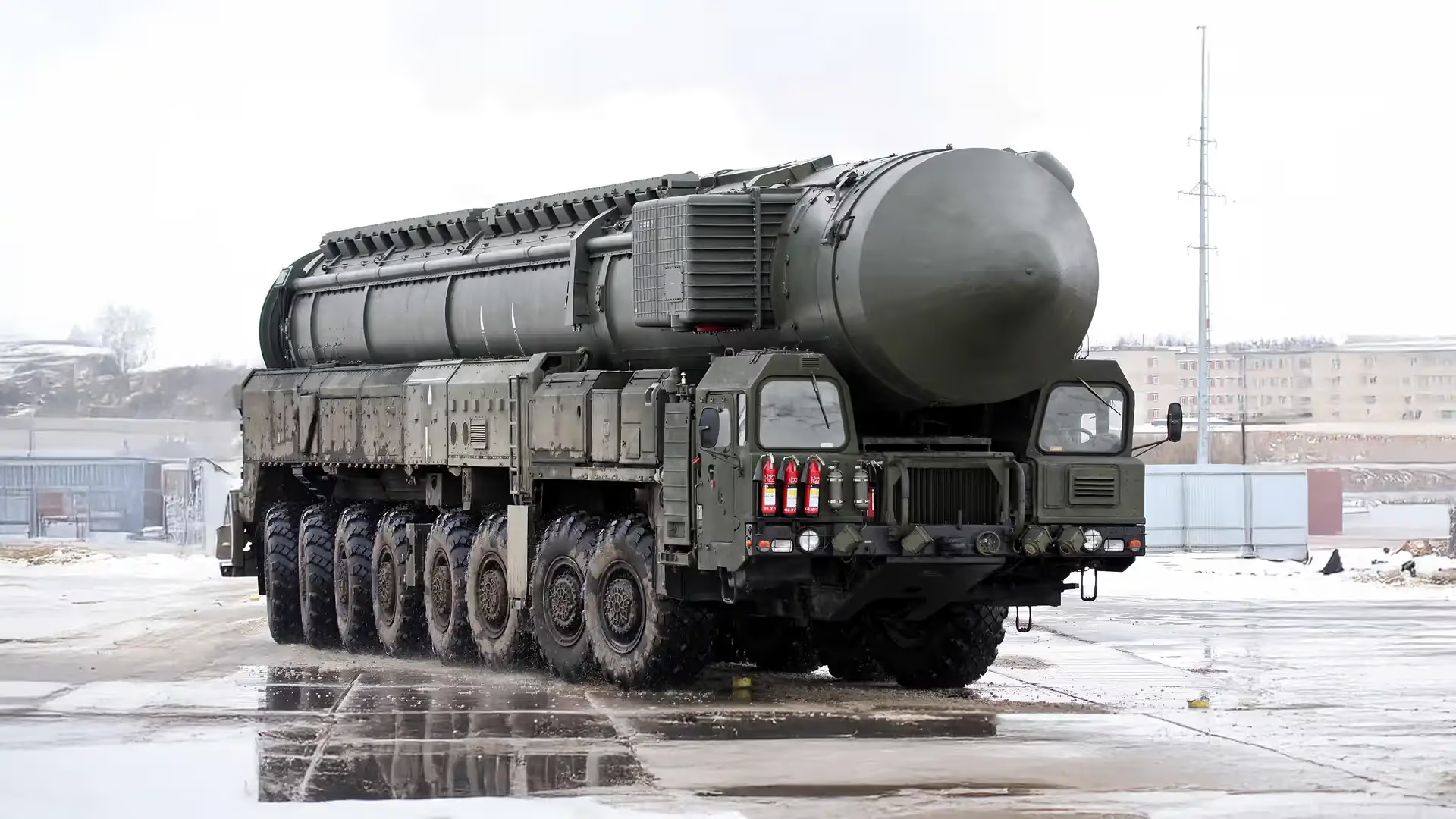
How China is powering Putin’s deadliest new weapon - The Telegraph - Sophia Yan | Russia’s new Oreshnik missile, which can strike Europe within 20 minutes of launch, is being built with multiple inputs from China. In this widely syndicated and translated article, ImportGenius data reveals that China’s trade with Russia includes $10.3 billion in technology and advanced equipment, including $4.7 billion in microchips and memory boards, and a unique carousel lathe for turning and cutting metal.
Moscow ships container loads of banknotes to Tehran
Revealed: Russia’s secret $2.5 billion cash shipments to Iran - The Telegraph - Eric Williams | ImportGenius data identified a total of 34 shipments of cold hard cash, weighing more than 5 tonnes in total, from Moscow’s Promsvyazbank to Iran’s central bank over 4 months in 2018, shortly after then-U.S. President Donald Trump first imposed punishing sanctions on the Islamic Republic. Each shipment, which traveled by rail and sea, was valued between $57 million and $115 million, largely in €500 notes.

Latest updates: Chinese gold shipments to the port of Miami
Dictatorship grants two mining concessions to Chinese company that has already exported millions in gold to Miami - La Prensa | The China-Nicaragua-Miami nexus of mysterious gold shipments, first exposed with the help of ImportGenius last November, continues to generate headlines with the revelation that the Chinese mining company behind the shipments has received two more land concessions from the Nicaraguan government.
[CT2]
Business news
Council on Foreign Relations cites IG data on Chinese trade dependency
CFR poll shows Americans across party lines tie tariffs to affordability - Council on Foreign Relations - Rebecca Patterson | Amid this article’s in-depth reporting on how tariffs impact multiple aspects of daily life, the author cites data from ImportGenius’ own client publication, The Manifest, to show how America’s dependency on Chinese goods increases the cost of raising children.
A Chinese company is buying American oil — and selling it to Cuba
Chinese company in Cuba imports fuel for sale in dollars - Diario Las Américas - Editorial Staff | As Venezuela and Mexico have turned off its oil taps to Cuba in recent months, a Chinese company, Fujian Trebor Trading, has been purchasing oil from the United States and offering it for sale at Cuban ports.

Peru becomes a dumping ground for unsafe cancer treatments
Cancer drugs are being scrapped at huge scale after quality failures in Peru - The Bureau of Investigative Journalism - Paul Eccles et al | ImportGenius helped track shipments of substandard or unsafe cancer drugs and medicines into Peru, one of many countries whose regulatory systems routinely fail to vet the quality of imported medicines. The WHO estimates that countries spend a combined $30bn a year on substandard and falsified medical products.
Snakebites, antivenom, and the illicit medicine trade
Venom and vacuum: How Nigeria’s antivenom shortage turns snakebites into death sentences - Punch - Tessy Igomu | Drawing on another dimension of the BIJ’s research into the global medicine trade, this article describes the impacts of Nigeria’s shortage of antivenom for the treatment of snakebites. The data shows that $3.2m worth of substandard antivenom has been sold to at least 13 sub-Saharan African countries over the past five years.

Indonesia, with no diplomatic ties to Israel, imports Israeli military equipment
Did the Indonesian National Armed Forces import anti-UAVs from Israel? – Portal Islam – Editorial Staff | ImportGenius data reveals that Indonesia’s military has sourced anti-drone (anti-UAV) systems from Israeli suppliers, despite the absence of formal diplomatic relations between the two countries. Records show that shipments were routed via intermediaries, highlighting how defense procurement networks operate through third parties to bypass political sensitivities and scrutiny.
Spotlight: Russian sanctions evasion

Germany, Denmark, Netherlands and others implicated in illicit Russian trade
Many news organizations are investigating how Russia has been able to step up its war efforts in Ukraine despite crippling economic and trade sanctions. ImportGenius data and analysis has helped uncover multiple examples of how Russia has been able to secure essential kit from Europe — and sell its own banned products there — all while evading authorities.
Made in the EU, dropped on Kyiv: How European parts are enabling Russia’s winter drone war - The Organized Crime and Corruption Reporting Project - Ingrid Gercama et al | ImportGenius data exposed the rerouting of European components to Russia via China and Hong Kong.
A Russian agent in Germany and the glycerin trade - Correctiv - Max Bernhard and Alexej Hock | This article tracks down the source behind recent shipments from Germany to Russia of glycerine, a raw material for many explosives.
Dutch company Ellis Enterprises allegedly exported sanctioned oil products to Russia - RTL Z - Matthias Pauw | Data shows that the European division of Valvoline has been repeatedly exporting lubricants and other sanctioned oil products to Russia.
Russian Ferrochrome reaches Europe through through a Swiss-Indian-Estonian trading chain - Hab.Media - Olena Yurchenko | Trade data follows the byzantine path of ferrochrome, an essential ingredient in stainless steel, from Russia into Europe in order to evade sanctions
Danish company collaborated to send equipment worth millions to Russian military factory - Berlingske - Julie Schneider, Louie McPherson and Dylan Carter | The meandering trail of dual-use equipment provided to Russia, via Azerbaijan and Hong Kong, by the Denmark offices of the industrial engineering firm East Consult.
Five Asturian industries exported dual-use equipment to Russia between 2019 and 2022 - Nortes - Bernardo Àlvarez | This article identified five companies from the Asturias region of northern Spain that exported equipment with both civilian and military uses, in contravention of EU sanctions regulations.
Sanctioned goods to Russia - Suomen Kuvalehti - Jukka Heinonen | ImportGenius data showed how Finnish businessman Gabriel Temin’s companies, Siberica and Luminor, exported defense equipment to Russia. Temin was handed a nine-month suspended sentence for the crime.
Investigations

How fentanyl precursor chemicals flow from China and India to North America
The precursor pushers – The Globe and Mail – James Griffiths and Kathryn Blaze Baum | ImportGenius data helps trace shipments of precursor chemicals used in fentanyl production from suppliers in China and India to buyers in North America, despite tightening regulations.
How a Ukrainian agribusiness used global trade to cut investors out of profits
Kernel scheme: how Andrey Verevskyi diluted shares and moved billions out of Ukraine – Antikor – Editorial Staff | ImportGenius data helps map the international trading activity tied to Kernel Holding and its affiliates, illustrating the scale of the company’s global operations and supporting allegations that corporate restructuring and trade mechanisms were used to shift profits abroad and sideline minority investors.
Where a Belgian zoo’s buffalo now roam
Animal transfers: why Pairi Daiza sent seven buffalo to a controversial zoo in India – Knack – Lotte Bebrauwer | ImportGenius data helps trace the international transfer of seven buffalo from Belgium’s Pairi Daiza zoo to a privately run wildlife park in India, drawing scrutiny from animal welfare groups over the destination facility’s standards and oversight.
Unmade in China, remade in Kazakhstan
Are QazTenha buses from Kazakhstan or China? – Azattyq | ImportGenius data sheds light on long-simmering suspicions that buses ostensibly made in Kazakhstan are in fact made in China, disassembled, and shipped as parts to Kazakhstan and then rebuilt — all just to qualify for a government industrial subsidy.
Looking ahead: The IG research team’s picks
Patrick’s Pick: Qatalum Shifts from Full Shutdown to 60% Capacity: Operational Update Amid Strait of Hormuz Disruption - Shanghai Metals Market (SMM) | The gulf region is responsible for roughly 20% of non-Chinese aluminium supply, and the fate of the Qatalum smelter reflects the fragile state of global markets due to the US-Israel-Iran conflict. Qatalum managed to secure a reduced gas supply that avoided a full shutdown — a procedure that requires a minimum six-month period to restart. But the risk of a full shutdown still looms, as finished metal can’t be exported to global markets and the supply stability of Qatalum’s inputs are also in flux.
William’s Pick: Iran war has U.S. farmers worried about the cost and availability of fertilizer - Associated Press - Jack Dura | Some 15% of US fertilizer imports come from the Gulf region and U.S. farmers are about to urgently need vast quantities of fertilizer for spring plantings. Moreover, many of America’s other global fertilizer suppliers use raw materials sourced from the Gulf, putting their supply at risk as well. Bangladesh has already shut down fertilizer factories due to a lack of Qatari natural gas. In addition, “about half the global supply of the key ingredient urea comes from the region, along with 30% of ammonia, according to the American Farm Bureau Federation.” The U.S. is relaxing sanctions on Venezuela, a major fertilizer producer, and scrambling to source fertilizer from Morocco.
Lynn’s Pick: Psychological Aspects of Mine Warfare - Naval Studies Group - William L. Greer & James C. Bartholomew, Cdr., USN | This paper from 1983 is well worth the read today, given current events. "Mine warfare has suffered a history of neglect punctuated by infrequent renewals of interest [which] delude us into believing that somebody still has a handle on it (…)The more minefields control ship movements, the greater the effectiveness of the minefield. Control results from human perceptions of potential damage and arises from that aspect of mining which is often given a solemn nod but rarely emphasized because of its slippery nature: the psychological impact of a minefield."
[CT1]

Get ImportGenius working for you

Uncover the trade secrets that matter to you


More News Articles





Ready to see how ImportGenius can unlock your business?
Get ImportGenius working for you