.avif)
.webp)
As major manufacturers’ import volumes seesaw by the month, Chinese automakers continue pushing deeper into North America
What you’ll learn in this article:
- How imports of vehicles from Mexico dropped sharply after a record-setting fourth quarter.
- Which manufacturers reduced import volumes the most — and which automakers continue to gain ground despite tariffs.
- Why Chinese vehicles have become a wildcard for the North American auto sector.
🎯 Best for: Strategic planning executives across the automotive, steel, and plastics industries.
Vehicle imports from Mexico to the United States fell 34% in Q1 of 2026, according to trade data analyzed by ImportGenius, but the bigger story may be who is gaining ground amid the slowdown. As North American automakers pull back and tariffs reshape supply chains, Chinese manufacturers are rapidly expanding across Mexico and Canada, potentially creating new pathways into the U.S. market.
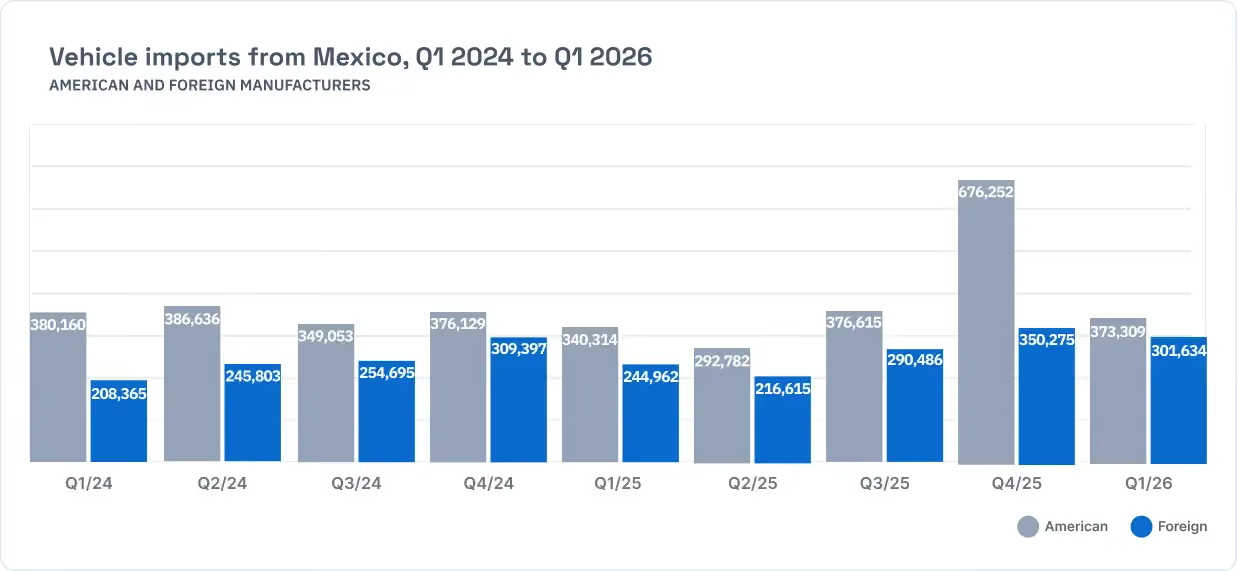
The decline comes after a massive fourth-quarter surge, when manufacturers shipped more than 1 million vehicles from Mexico to the U.S. — the highest quarterly total in the last two years.
The eight largest importers of cars from Mexico — Honda, Mazda, Nissan and Toyota from Japan, Korea’s Kia Motors, and American manufacturers GM, Ford and Stellantis — brought 351,584 fewer cars into the U.S. in Q1 than they did in Q4. Total imports for the quarter, at 674,943 vehicles, fell sharply from 1,026,527 in the previous quarter.
This latest import slowdown arrives at a moment when the North American automotive market is becoming more complicated, not less — a situation that is mirrored across multiple industries. Tariffs and USMCA negotiations continue to reshape supply chains. The closure of the Strait of Hormuz has halted shipments not only of oil but of aluminum and chemicals required for plastics manufacturing. Many critical minerals remain under Chinese export restrictions. Meanwhile, Chinese automakers are steadily expanding their footprint in Mexico and Canada — and, according to recent trade data analyzed by ImportGenius, may already be finding indirect pathways into the United States.
“What the data shows is not a collapse, but a reset,” says ImportGenius founder and CEO Michael Kanko. “Automakers appear to have pulled significant volumes forward at the end of last year, then eased back in the first quarter. Meanwhile the competitive landscape is changing rapidly, given the rise of Chinese manufacturers in North America.”
Foreign manufacturers held up better than domestic automakers. Imports by American manufacturers fell 45% from Q4 to Q1, compared to a 14% drop for foreign manufacturers. Domestic automakers accounted for more than 300,000 of the quarter’s 351,584-vehicle decline. Even so, both groups remain ahead of where they stood a year earlier: American manufacturers imported 10% more vehicles from Mexico in Q1 2026 than in Q1 2025, while foreign manufacturers increased imports by 23% over the same period.
“Tariffs were intended to discourage imports and shift more production back to the United States,” says Kanko. “But the data continues to show how deeply integrated North American auto manufacturing has become.”
Import data: GM, Stellantis and Ford drive the decline
The first-quarter slowdown was led by the three American automakers. GM reduced its Mexican imports by 138,987 vehicles from Q4 to Q1, a 42% decline. Stellantis imports fell by 96,124 vehicles, or 51%, while Ford reduced imports by 67,832 vehicles, a 42% decline. Nissan also posted a significant decline, with imports falling by 49,832 vehicles, or 35%, after a strong fourth quarter.
Only two manufacturers increased volumes from Q4 to Q1. Mazda nearly doubled its imports, rising 98% from the previous quarter, though it remains by far the smallest importer in the group. Kia increased imports by 16%, bringing 48,826 vehicles into the U.S. in Q1. Toyota and Honda posted comparatively modest declines of 7% and 8%, respectively, suggesting more stable import patterns than the others.
.avif)
Thankfully for consumers, vehicle prices have stabilized amid the contraction at $25,500 in Q1, up from $25,300 in Q4, though pricing strategies varied by manufacturer. Mazda and Nissan both increased prices by 20% or more over last quarter. Meanwhile, compared with Q1 2025, prices were down 18% for Toyota, 14% for Ford, 13% for Honda and 6% for GM.
“For suppliers, the key takeaway is that every manufacturer is moving differently,” says Kanko. “Some are rebuilding volumes. Others are still managing their exposure and absorbing pressure. That creates both risk and opportunity across the supplier base.”
Chinese automakers: the industry’s next disruption?
While North American manufacturers continue adjusting to tariffs and shifting trade rules, Chinese automakers are rapidly establishing market presence with America’s neighbours. As reported by The Wall Street Journal, Chinese-made vehicles have become increasingly common in Mexico, where brands such as BYD, Chery, Geely and Great Wall Motors are aggressively expanding dealership networks and targeting lower-priced segments that many Western manufacturers have largely abandoned. Canada, meanwhile, has agreed to allow up to 49,000 Chinese-built vehicles into the country this year under an agreement signed late last year.
And despite U.S. restrictions on Chinese vehicle imports, shipping data analyzed by ImportGenius for The Wall Street Journal’s investigation suggests that some companies may already be exploring ways around those barriers. California-based EV manufacturer Faraday Future has imported prototype vehicles from Chinese automaker Zeekr, a premium electric brand owned by Geely. The imports appear connected to efforts to modify and assemble vehicles in California using Faraday technology.
The development highlights growing concerns within the U.S. auto industry that Chinese manufacturers may eventually gain indirect access to the American market through partnerships, component imports, or North American assembly arrangements.
A volatile year ahead for North American autos
The first-quarter data lands at a pivotal moment for the North American auto industry. The United States-Mexico-Canada Agreement is facing a mandatory review in 2026, with formal talks expected to begin later this spring. U.S. negotiators are reportedly considering stricter North American content requirements for vehicles and major components.
At the same time, Chinese automakers continue expanding globally at extraordinary speed, backed by lower manufacturing costs, strong battery supply chains and increasingly sophisticated EV technology. The situation echoes the same kind of disruption previously triggered by Japanese and Korean automakers in earlier decades.
That makes the latest import data especially important. After a volatile year of tariff adjustments, inventory swings and shifting prices, Mexican auto imports remain a major pillar of the U.S. vehicle market. But the next major competitive battle may no longer be solely between American, Japanese and Korean automakers alone.
ImportGenius’ trade database can track the daily movement of goods — from finished vehicles to auto parts, semiconductors and critical minerals — giving decision-makers a clear, real-time view of who is shipping what to whom.
“With volumes moving this sharply from quarter to quarter, suppliers cannot afford to wait for earnings calls or annual reports,” Kanko says. “Trade data shows the changes as they happen.”
[CT1]

Dive deep into any supply chain

Dive deep into any supply chain


More blogs & reports
.avif)