


From stopping car thieves to promoting trade, Canada and its partners would benefit from open manifest-level data.
What you’ll learn in this article:
- How Canada’s trade data system compares to the United States’.
- How vehicle theft has become an epidemic in Canada.
- Why Canada is investing billions in its trade infrastructure.
🎯 Best for: Supply chain leaders, government relations executives, trade data analysts.
Canada’s lack of trade data transparency is hampering the country’s efforts to promote trade, fight crime, and improve its reputation.
In a recent article for The Globe and Mail, Canada’s newspaper of record, and in broadcast interviews, ImportGenius Chief Technology and Product Officer James Orr argues that Canada should follow the example set by countries like the U.S. and Mexico and adopt open trade data policies.
Canada is the United States’ second largest trading partner, behind Mexico and ahead of China. In 2025 the U.S. imported US$383 million worth of Canadian goods, while exporting a total US$336 million in goods north of the border.
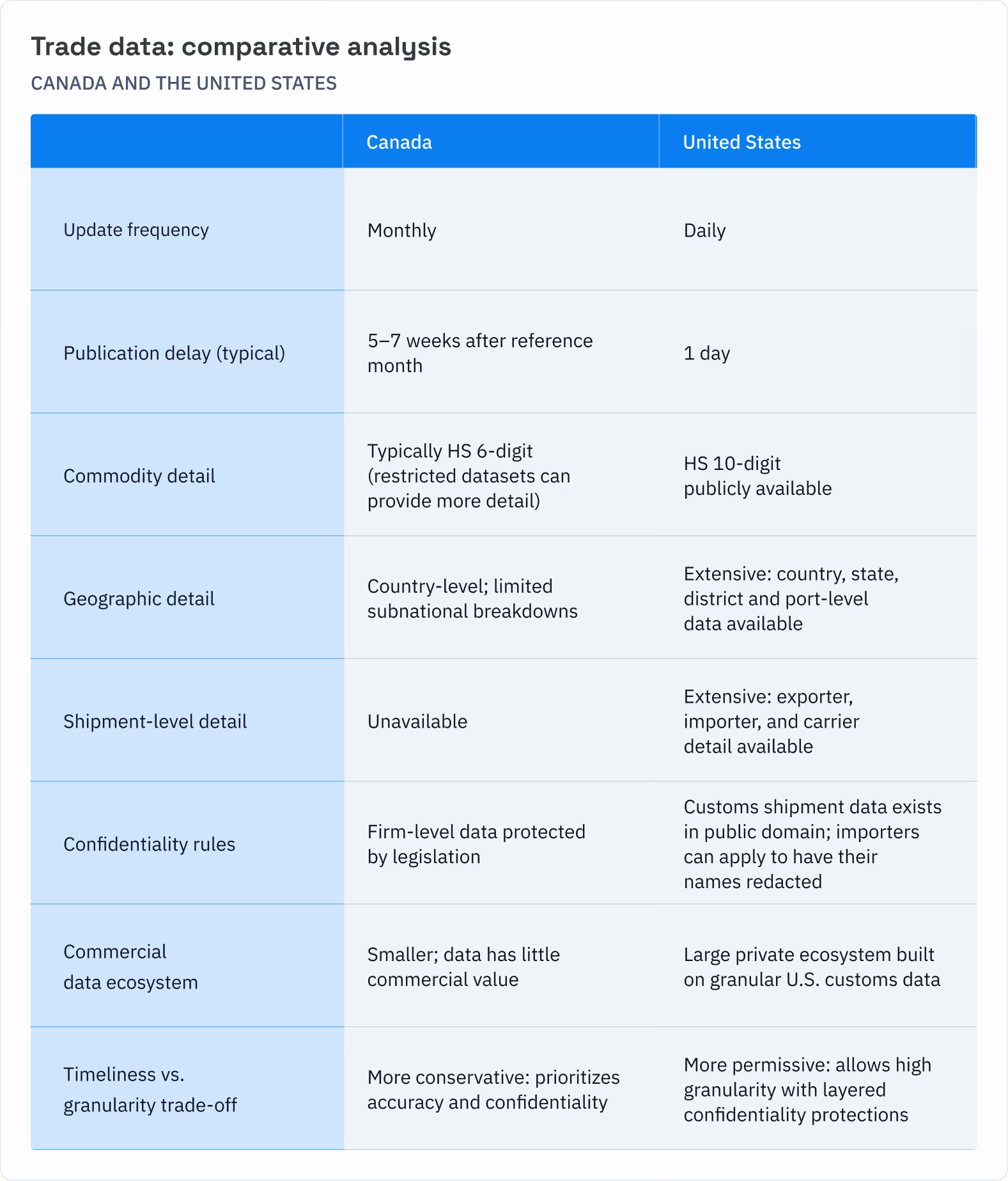
But unlike the U.S., Canada does not make its manifest-level shipping data public. While the United States openly publishes manifest data from all seaports — including the names of importers, exporters and shippers, the ports of origin and destination, and descriptions of contents — and updates it daily, Canada publishes its trade data monthly, in aggregate form, after a five-week delay, with no identifying details for individual shipments.
“Open, manifest-level trade data makes global commerce safer, smarter and more accountable,” says ImportGenius CEO Michael Kanko. “The way Canada keeps its trade data hidden is undermining its law enforcement and its economy.”
Stolen cars and fentanyl trafficking
In recent years Canada has become a hotbed for vehicle theft, with more than 47,000 vehicles stolen in 2025, and insurance claims totalling more than Cdn$900 million (US$659 million).
Many of those stolen cars end up in black markets in Africa and elsewhere. Because Canadian manifest data for the shipping containers that carry them overseas is not made public, it is impossible for individual victims or insurance companies to investigate. Even Canadian law enforcement agencies have limited access to the data, despite the fact that it is collected and updated daily by the Canada Border Services Agency (CSBA).
Meanwhile, Canada has been singled out by the current U.S. administration in Washington (along with Mexico and China) for its role in the global fentanyl trade. Canada insists its role in fentanyl production and transit is minimal. But since the country does not publish its manifest-level trade data, observers are unable to track shipments of fentanyl precursor chemicals to Canadian ports.
“In the United States, our experience has shown that open trade data helps deter crime and can be used to solve crimes,” says Kanko. “Canada would reap similar benefits from similar policies.”
Open data means an efficient, open economy
Last October, Canada set a goal of doubling its non-U.S. exports by 2035. As part of those efforts, the government there is investing Cdn$5 billion (US$3.5 billion) in its domestic trade corridors, including major port expansions and upgrades. But without modernized trade data policies and systems, the country’s efforts could fall short.
Without publicly available trade data, businesses in the United States and elsewhere are hard-pressed to discover Canadian exporters who could help them. Currently, Canada only publishes monthly aggregate trade data on a five-week delay — which one expert characterized as “ancient history” in the information economy — and removes all individual company names, providing little depth of detail.
“We know that millions of companies use manifest data to expand into new global markets, source new foreign suppliers, and assess potential partnerships or acquisitions,” says Kanko. “Right now, Canada is standing on the sidelines of all those business dealings. It’s extremely difficult to find information on any Canadian company, because Canada doesn’t publish its trade data.”
Put trade data to work for your business
Canada does not make its trade data public, but there are dozens of other countries around the world that do, including Vietnam, Indonesia, the Philippines, Panama, India, Argentina, Chile and Venezuela. For any business that manages a global supply chain, trade data can help you find new suppliers, track competitors, manage shipments, and even reduce tariff exposure.
“Manifest data is powerful information,“ says Kanko. “It boosts competitiveness, reduces costs, and helps goods move quickly and safely. In a world where supply chain decisions are made faster than ever, this kind of information is more valuable than ever.”
[CT1]

Find out what you’ve been missing

Find out what you’ve been missing


More blogs & reports


.avif)