
The latest investigation results — and the tariff increases that will accompany them — will impact most of America’s top trade partners
What you’ll learn in this article:
- Which 16 countries could see new tariffs as early as next Friday.
- Why the Trump administration is in a hurry to impose the tariffs.
- Which sectors are most at risk, and what companies can do to prepare.
🎯 Best for: Procurement leaders, logistics executives, supply-chain managers, importers, and market intelligence teams.
The Office of the United States Trade Representative (USTR) is slated to announce the results of its latest Section 301 investigation as early as next Friday. That announcement is likely to include a series of new tariffs that will disproportionately impact most of America’s largest trading partners, including Mexico, China and the European Union.
The tariff increases are the anticipated result of yet another investigation under Section 301 of the Trade Act of 1974, which was used last month to impose tariffs on 60 countries for failing to combat forced labour. This latest investigation has targeted 16 different countries accused of maintaining “Structural Excess Capacity and Production in Manufacturing Sectors” — in other words, they are producing far more manufactured goods than their domestic markets consume. The administration has targeted next Friday, July 24 to announce the investigation’s results.
“Washington is using Section 301 investigations to rebuild the tariff walls that were struck down by the Supreme Court back in February,” says ImportGenius CEO Michael Kanko. “And these 16 countries represent more than 60% of all U.S. trade, so the results will impact just about any business with a global supply chain.”
The race to replace Section 122 tariffs
Next week’s expected announcement will be the latest in a sequence of events that began last year, when many small businesses challenged the legality of tariffs imposed under the International Emergency Economic Powers Act (IEEPA) — more commonly known as the Liberation Day tariffs.
- On February 20, the Supreme Court struck down the IEEPA tariffs.
- Later that same day, the administration imposed tariffs of 10% on all its trading partners under Section 122 of the Trade Act. These tariffs automatically expire after 150 days, on Friday July 24, 2026.
- On March 11 and 12, the USTR announced the start of 2 Section 301 investigations against multiple trading partners: one for failing to combat forced labour (60 countries), and another for excess manufacturing (16 countries).
- On June 2 the USTR swiftly concluded its forced labour investigation, imposing additional tariffs of 10% or 12.5% on all 60 countries.
The July 24 expiry date for the Section 122 tariffs explains the desire to conclude the excess manufacturing investigation quickly: the administration wants to replace those expiring tariffs with new ones.
New tariffs would target America’s top trading partners
All told, the excess manufacturing investigation encompasses nine of America’s top 12 global trading partners, and the findings could result in different tariff rates for each one. And when stacked atop existing Section 301 tariffs, some countries could find themselves at a significant disadvantage.
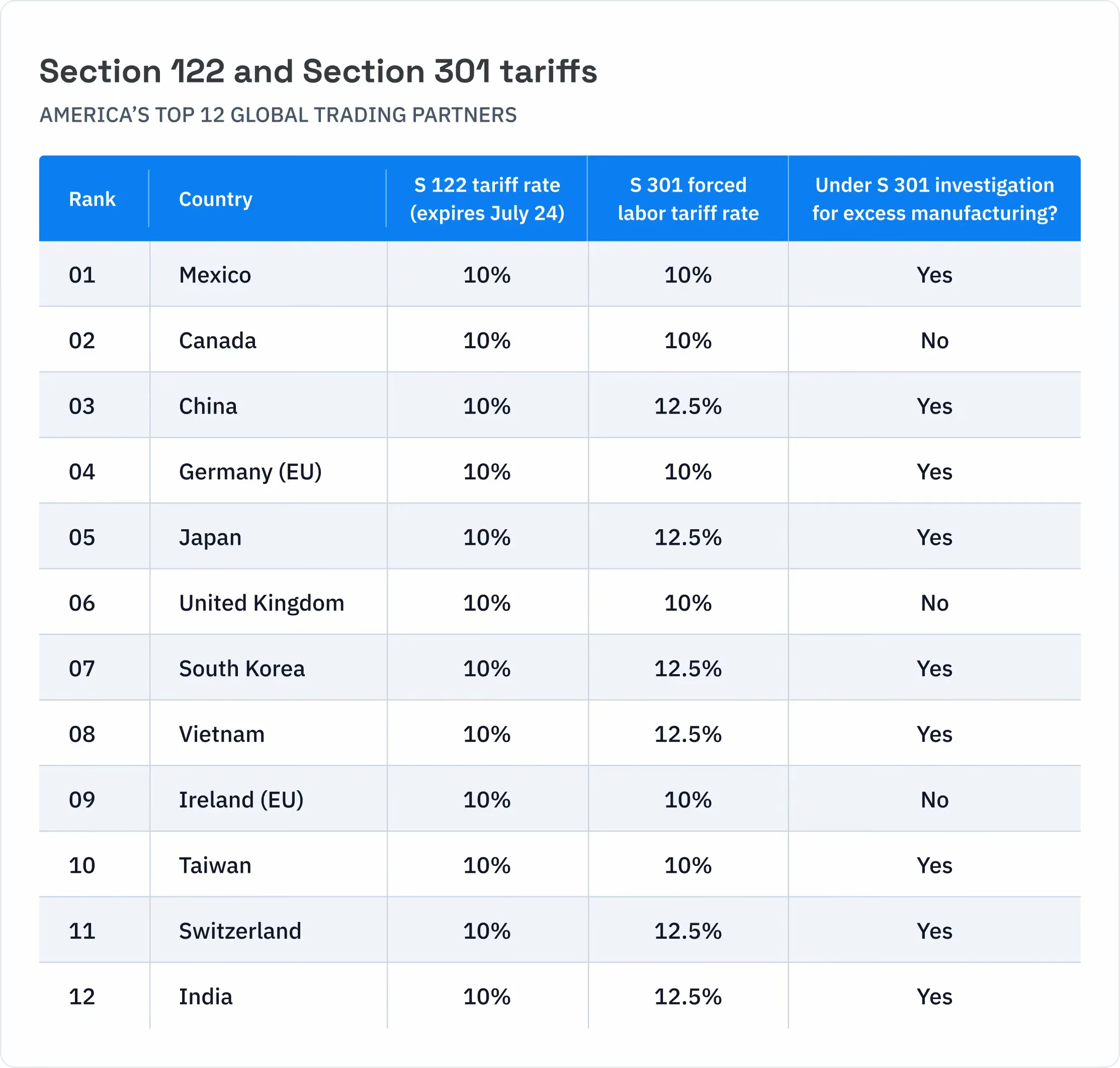
In addition to the 9 countries in the list above, the excess manufacturing investigation also applies to Norway, Cambodia, Indonesia, Bangladesh, Malaysia and Singapore. Meanwhile, China is already subject to a dizzying array of tariffs from previous Section 301 rulings, while additional investigations are currently underway regarding South Korea, Germany and Vietnam.
Section 301 tariffs are typically lifted through bilateral negotiations — and the onus is on America’s trading partners to prove they have changed their trade practices.
“One of the purposes of these tariffs is to force countries back to the negotiating table, where concessions can be extracted,” says Kanko.
Targeted sectors and more: What businesses need to know
For many importers, the biggest risk won't be whether tariffs increase—but whether key suppliers become significantly more expensive than competing sources. In addition to listing 16 specific countries, the investigation lists a total of 21 specific sectors where it will focus its inquiry. It’s an expansive list that can be separated into 3 broad categories:
- Primary inputs: steel, aluminum, cement, chemicals, glass, non‑ferrous metals, paper, and plastics.
- Finished industrial goods: automobiles, ships, machinery, machine tools, transportation equipment, and processed food and beverages.
- Advanced technologies: batteries, solar modules, semiconductors, robotics, satellites, electronics, and energy goods.
“The tariff rates remain an open question for now, but we know that new tariffs are coming,” says Kanko. “Supply chain leaders need to re-assess their risk exposure, make contingency plans, and act to minimize disruptions.”
[CT1]

Find alternative suppliers before tariffs hit

Find alternative suppliers before tariffs hit


More blogs & reports

.avif)