
North America's trade deal faces a critical test
Brokers, 3PLs and supply chain teams brace for more uncertainty as USMCA negotiations heat up
What you’ll learn in this article:
- What’s at stake in negotiations between the US, Mexico and Canada
- How Mexico became the USMCA’s big winner, overtaking Canada in total US import volumes
- How the supply chain and logistics sectors can prepare for any changes to the deal
🎯 Best for: Procurement teams, logistics executives, supply-chain managers, importers, and market intelligence teams.
Negotiators for the United States, Mexico and Canada launched an official review of the USMCA trade agreement this week, part of a series of meetings that could decide the deal’s eventual fate.
The review provides an opportunity to extend, renegotiate, or effectively kill the agreement. If they don’t extend it, the USMCA deal would most likely enter a cycle of annual reviews, negotiations, and potential amendments. And if any country decides to withdraw from USMCA entirely, the agreement would quickly break down into a series of fragmented, bilateral trade deals subject to individual renegotiation.
Either of those outcomes would result in a cascade of problems and headaches for the supply chain and logistics sectors.
“Many companies have built their business models around the USMCA’s rules, and prolonged uncertainty around the deal places their future plans in limbo,” says ImportGenius founder and CEO Michael Kanko. “Deals like the USMCA are negotiated by politicians, but they succeed or fail based upon the daily execution of logistics and supply chain professionals.”
How USMCA has reshaped North American trade
Tariff-free trade has been a feature of the North American market since the original 1994 North American Free Trade Agreement (NAFTA). Mexico, the junior partner in that initial agreement, has since grown to become America’s top trading partner, surpassing both Canada and China in the process. In 2025, the U.S. imported $535 billion worth of Mexican goods — an increase of 6% from the year before — compared to $383 billion from Canada and $308 billion from China.
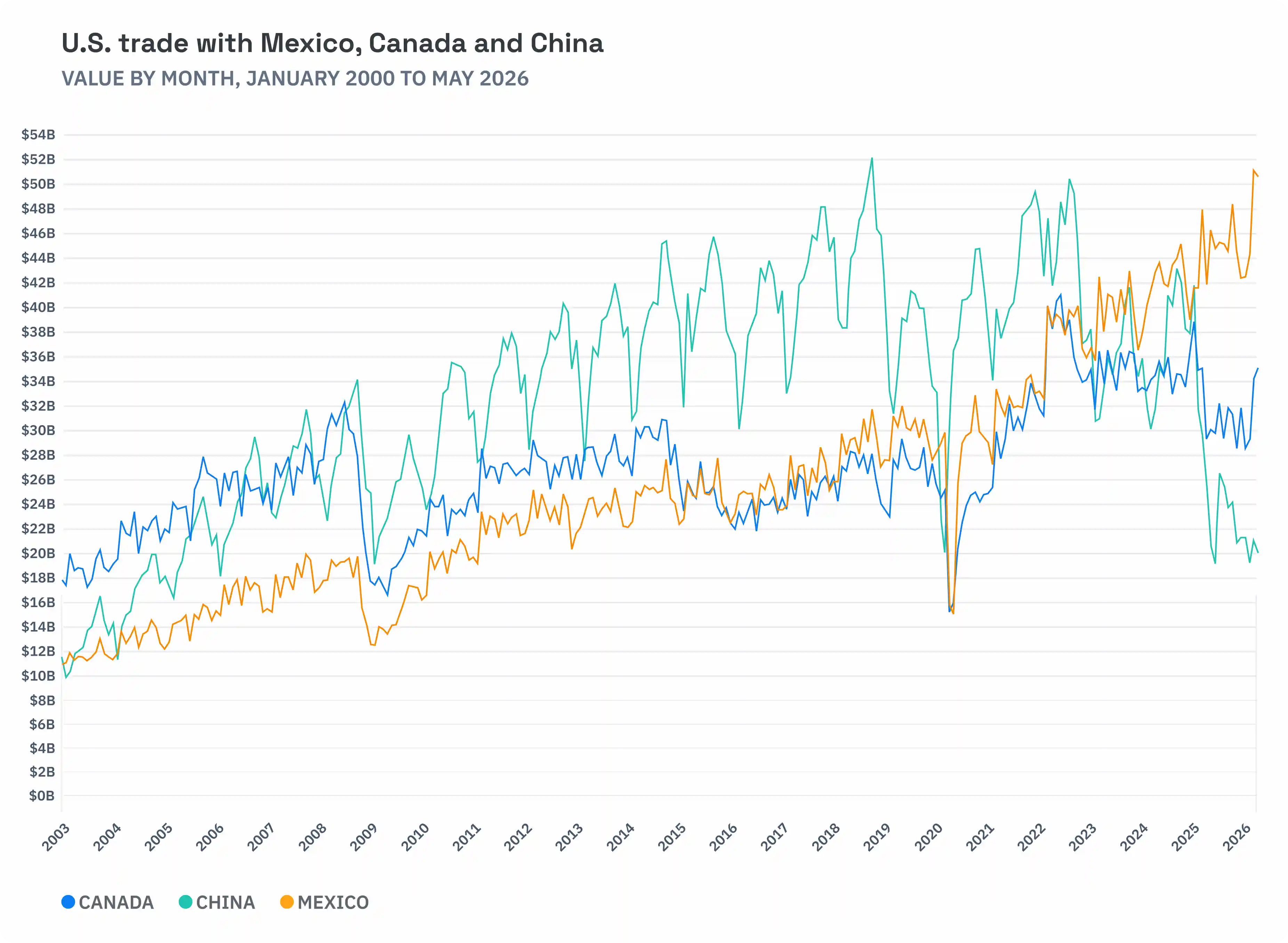
Thanks to Mexico’s growth, the landlocked Port of Laredo, TX has emerged as a new epicenter of American commerce, handling roughly two-thirds ($354 billion) of all US-Mexico trade. Last year, Laredo surpassed Long Beach, CA, the country’s largest maritime port, in terms of total TEU throughput.
“That statistic really puts the USMCA into clear focus,” says Kanko. “Long Beach receives shipments from every country in the world. Laredo receives shipments solely from Mexico, and it’s become the country’s single busiest port.”
The city of Laredo is in the midst of a series of multi-billion-dollar infrastructure upgrades to improve the movement of goods. It will also host a major new Global Trade Summit next week, testament to its emerging status as a megahub of American trade.
Friction points and business imperatives
A key point of contention in USMCA discussions revolves around automotive rules of origin. The US wants to increase the threshold for tariff-free status from 75% North American origin to a combination of 82% North American and 50% US origin.
That amendment, if adopted, could add a complex set of new wrinkles to an already challenging problem for supply chain and logistics teams: documenting the rules-of-origin proofs to qualify for tariff-free status, especially when parts can cross the border more than once in the manufacturing process. The current formula already includes more than half a dozen variables, including opaque criteria such as regional value content (RVC) and labour value content (LVC). Many companies already struggle to stay on top of them.
“No matter what changes are made to the rules, the compliance burden will fall largely on the private sector,” says Kanko. “Companies need to master the rules we have now and put systems in place that will make it easier to adjust to any changes.”
What manifest data can reveal about USMCA trade
Companies also need to explore the growing opportunities that Mexico represents for nearshoring their supply chains and integrating new partners — a job tailor-made for trade data.
North America has typically been a blind spot for trade data: most of that trade moves overland, while US trade data is limited to maritime ports. But ImportGenius’ new Mexico all-modes dataset covers maritime, air, rail and road shipments, providing companies with a truly complete picture of US-Mexico trade — plus all the granular detail about who is shipping what across the border.
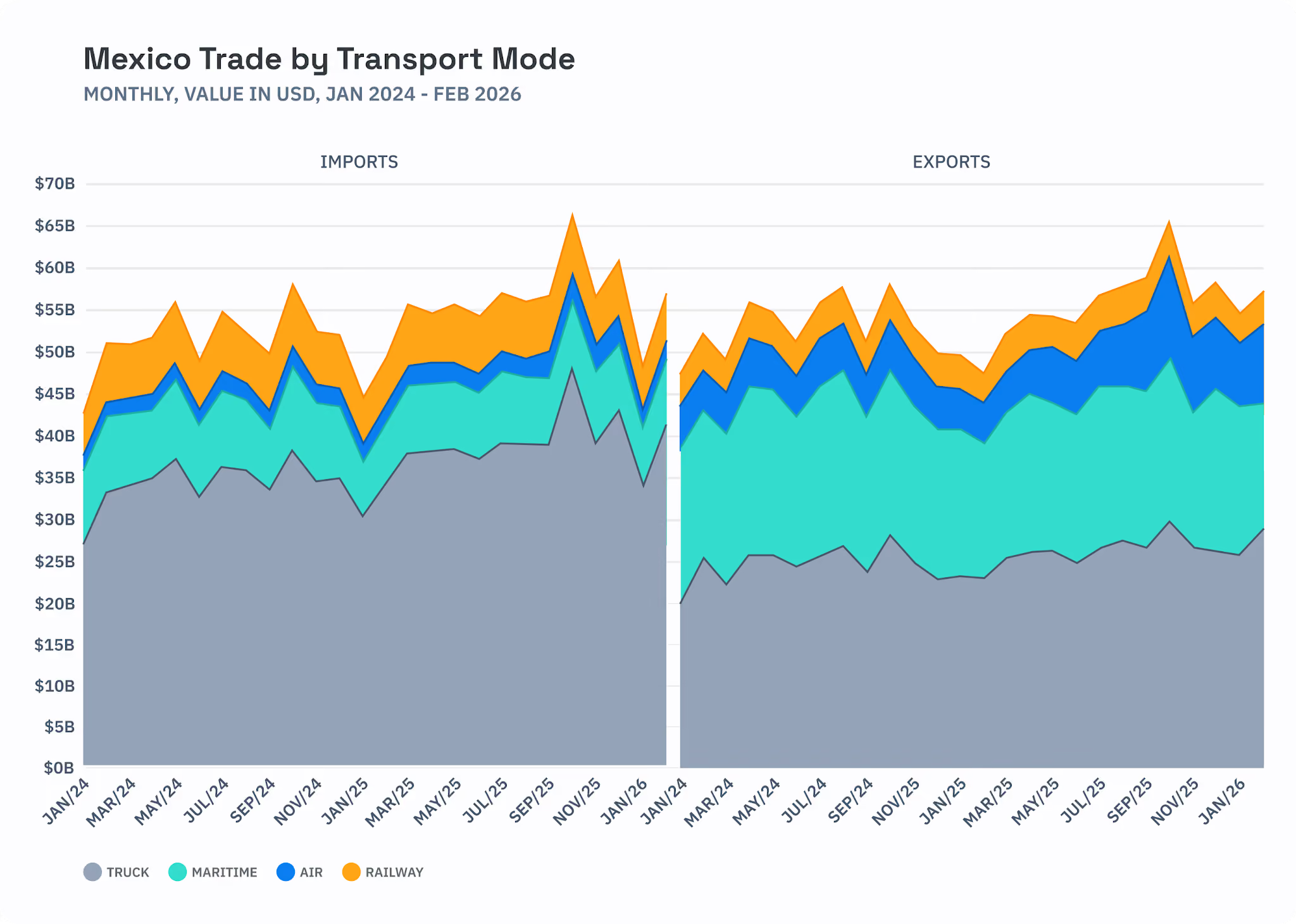
The ability to see all modes, rather than just maritime shipments, can identify new potential partners, uncover fresh information about competitors, and help logistics providers track down qualified leads.
“No matter what happens to USMCA, Mexico has become a driving force in America’s global trading relationships,” says Kanko. “Our data helps take the guesswork out of the job for the procurement, supply chain and logistics sectors.”
[CT1]

Laredo like you’ve never seen it before

Laredo like you’ve never seen it before


More blogs & reports
.avif)