How companies use manifest-level intelligence to uncover patterns, act fast, and reduce risk
In this article, you’ll learn how to:
- Uncover hidden supplier relationships your competitors already leverage
- Spot early warning signs of disruption through real-time trade activity
- Stress-test your supply chain against real-world data
🎯 Best for: Procurement and supply chain leaders looking to move from reactive risk management to real-time market intelligence.
Stories abound of American companies that spent years or decades optimizing their supply chains—only to see that work undone in a matter of weeks by market shocks and shifting trade policy.
Their stories underscore a basic truth about supply chains. The fact is that, while most decisions are made using internal data such as purchase orders, supplier contracts, and ERP systems, the most important signals that affect your company’s supply chain lie outside your organization.
“Companies have built sophisticated internal systems to manage their supply chains,” says ImportGenius CEO Michael Kanko. “But without visibility into external forces as they unfold, you’re only seeing half the picture.”
Trade data, especially at the manifest level, captures the kind of intelligence that internal systems do not, such as what your competitors are doing, how markets are shifting, and where risk is quietly building. Until recently, this kind of analysis required weeks of manual work across massive datasets. Today, AI-powered tools can process millions of shipment records in seconds—surfacing patterns, anomalies, and opportunities that would otherwise go unnoticed.
Three of the most valuable signals are hidden in plain sight within trade data—and leading companies are already using them to get ahead.
1. Hidden supplier networks
Most companies have, at best, a partial view of their supplier landscape. They know their own vendors, but not necessarily who else those vendors serve, or what alternatives exist beyond their current network.
Trade data changes that. At the shipment level, it becomes possible to map relationships between exporters and importers across entire industries. Patterns begin to emerge, such as competitors sourcing from overlapping suppliers, regional firms gaining traction with multiple buyers, and smaller firms working with specialized manufacturers.
With AI-assisted analysis, these networks can be identified and visualized quickly—highlighting clusters of activity that would be nearly impossible to detect manually. Even for smaller manufacturers, the networks can be surprisingly expansive.
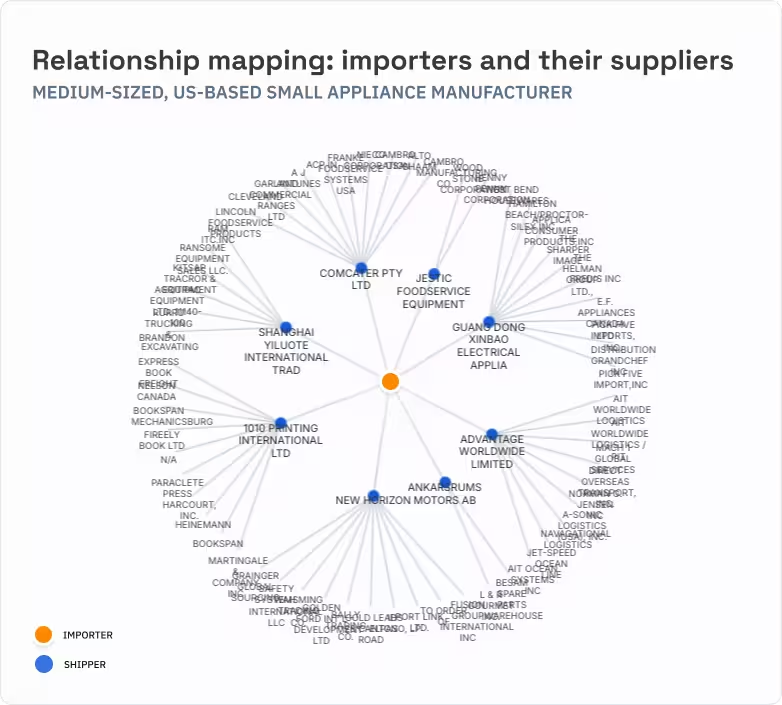
Trade data can augment your ability to manage your supply chain, allowing you to:
- Identify alternative suppliers already vetted by your competitors,
- Discover niche or emerging manufacturers before others do, and
- Benchmark your sourcing strategy against others in your industry.
Trade data is a form of competitive intelligence: not just showing where goods come from, but revealing the structure of entire supplier ecosystems.
2. Shadow inventory
When companies anticipate disruption—tariffs, labor strikes, geopolitical tension—they often act before the news cycle catches up by stockpiling. It’s a tactic that leaves a clear signature in trade data: sudden, sustained increases in import volumes within specific sectors or product categories, or from specific regions, followed by steep import declines.
The telltale signs are clearly visible, as the Port of Newark, NJ (America’s largest east coast port) experienced in the early months of 2025: imports spiked just before new tariffs against China came into effect in March, then nosedived afterward.
.avif)
Because it’s updated daily, U.S. trade data gives companies the ability to spot import surges ahead of the news cycle and determine their cause, whether that’s anticipation of tariffs, port disruptions, contract negotiations, or geopolitical uncertainty. Modern tools can flag:
- unusual spikes relative to historical baselines,
- synchronized behavior across multiple importers, or
- timing correlations with policy or market events
Trade data is increasingly proving to be a more immediate indicator of real-world business sentiment than traditional measures like stock indexes. In effect, trade data allows you to see how companies are positioning themselves for the future—based on what they’re doing, not what they’re saying.
3. Supplier concentration risk
Many organizations believe they have diversified supply chains. But when mapped against real-world shipment data, a different picture often emerges. By adding external trade data to their internal processes, companies can stress-test their sourcing strategy against real-world dependencies such as:
- Heavy reliance on a small number of exporters,
- Geographic concentration in specific regions, and
- Hidden dependencies within upstream supply chains.
These risks are not always visible internally, especially when procurement is distributed across teams or regions. AI-driven analysis can aggregate and assess this exposure quickly, identifying points of failure or overconcentration thresholds that increase disruption risk — and build true supply chain resilience through targeted diversification.
Get the external data advantage
The companies gaining an edge in today’s supply chain environment are not just managing suppliers, they are reading the market in real time. Manifest-level data expands that capability—giving companies access to real-time, decision-ready insight drawn from millions of global shipments.
“Information is power, but only if you can access it, and only if you can trust it,” says Kanko. “Trade data isn’t abstract. It’s based on what’s in the containers that travel through port, allowing you to see what others miss.”
[CT1]

See what your supply chain looks like from the outside.

See what your supply chain looks like from the outside.


More blogs & reports

.avif)