
After consecutive double-digit quarterly declines to start 2025, vehicle imports from Mexico skyrocketed by 31% from July to September.
What you’ll learn in this article:
- How imports of vehicles from Mexico have made a strong comeback in the third quarter of 2025.
- Which manufacturers have fared best in terms of both manufacturing volumes and pricing.
- The shock waves ahead in 2026 for the global automotive industry.
🎯 Best for: Strategic planning executives across the automotive, steel, and plastics industries.
After months of contraction driven by tariffs and production pullbacks, global auto supply chains appear to be re-accelerating. Imports of Mexican-made vehicles to the United States rose a whopping 31% from July to September of 2025, according to trade data analyzed by ImportGenius. The increase represents a significant gain as the auto industry recovered from consecutive declines of 15% and 13% in the first and second quarters of the year.
The eight largest importers of cars from Mexico (Honda, Mazda, Nissan and Toyota from Japan, Korea’s Kia Motors, and American manufacturers GM, Ford and Stellantis) brought 157,704 more cars into the U.S. in Q3 than they did in Q2. Total imports for the quarter, at 667,101 vehicles, are the highest they’ve been since the fourth quarter of 2024. The increase comes amid the continued imposition of 25% tariffs on foreign-made vehicles, which has been in effect since April 3 of last year.
“What we’re seeing is that the automotive industry has made some adjustments in response to the new tariff regime,” says ImportGenius founder and CEO Michael Kanko. “After scaling back production through the first half of the year, they’ve found ways to increase output and replenish their inventories.”

Foreign manufacturers saw the largest quarterly gains with an increase of 34%, compared to 29% for domestic carmakers, leading to significant increases in new car inventories as the year drew to a close. “This is good news for the industry and for consumers, but it’s not necessarily a win for the U.S. government’s efforts to bring manufacturing back to the United States,” says Kanko. “Despite tariffs, vehicle imports from Mexico are clearly still going strong.”
Import data: Stellantis, Mazda, Honda lead the surge
The data shows that all eight manufacturers increased their Mexican imports to the United States in the third quarter, with most gains in the 18-25% range. The largest gain was registered by Stellantis, the maker of the Chrysler, Dodge, Ram and Jeep brands, whose imports rose by 70% in a single quarter, an increase of 42,945 vehicles. Stellantis’ totals returned the company to import levels not seen since early 2024.
Among foreign manufacturers, Mazda — by far the smallest of the eight carmakers studied —saw a quarterly import increase of 68%, or an additional 6,427 vehicles. More significantly, Japan’s Honda Motor Co. increased its imports by 47%, the company’s second consecutive quarterly increase. Since bottoming out in the first quarter of the year at 43,536 vehicles, Honda’s imports are up by 67% to 72,662 vehicles.

“For Stellantis, the latest data represents a new high for quarterly imports over the last 18 months,” notes Kanko. “Most other manufacturers are approaching similar heights.”
Prices in flux as industry adjusts to tariffs
While the data suggests that manufacturing output is returning to normal, it also shows that there’s nothing normal about vehicle pricing. Prices continue to fluctuate significantly depending upon the manufacturer. Compared to the third quarter of 2024, prior to the imposition of tariffs, both Kia and Ford have registered price increases of more than 10%, while Nissan and Toyota have reduced prices by more than 20%.
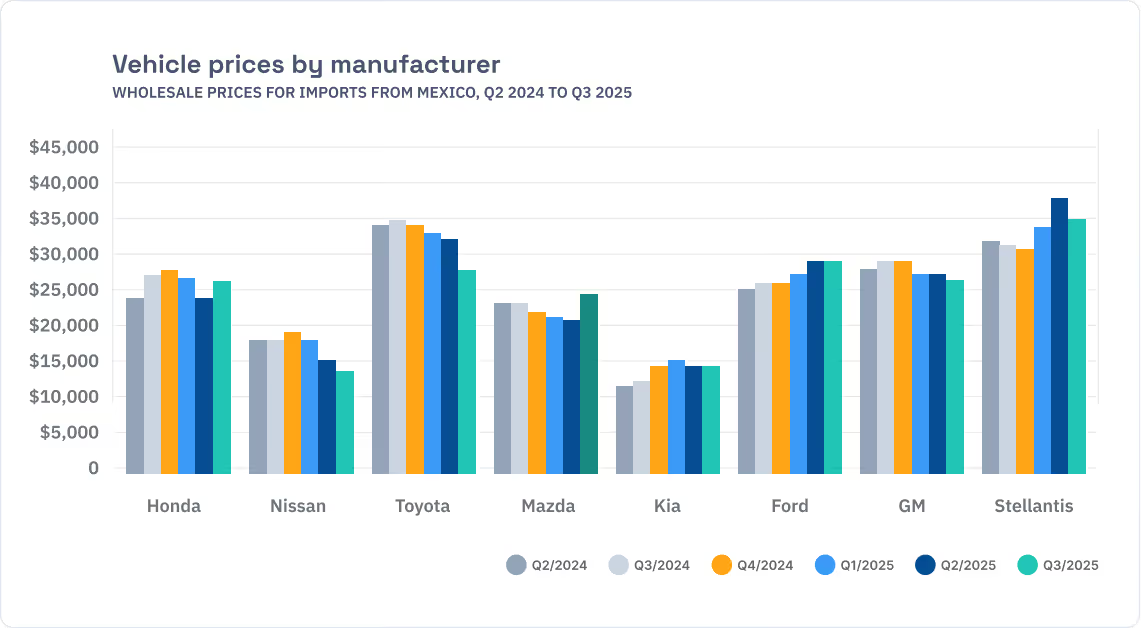
In terms of pricing, the most consistent performers have been General Motors, Toyota and Nissan, all of which have reduced prices for at least 3 consecutive quarters. “To judge from the data, it seems that some manufacturers have figured out the ‘secret sauce’ for continuously reining in prices despite tariffs, while others are still figuring it out,” says Kanko.
Danger ahead: rare earths, semiconductors, USMCA renegotiations
The industry’s third-quarter import recovery could prove fragile, as tariffs are not the only challenge facing its global supply chains. Recent Chinese trade restrictions on certain types of semiconductors forced some manufacturers, including Stellantis and Nissan, to slow production in the fourth quarter of 2025. The industry also remains reliant upon Chinese supplies of rare earth minerals, which are subject to China’s on-again, off-again export controls.
Meanwhile, the United States - Mexico - Canada Agreement, which provides a variety of tariff exemptions based upon country-of-origin for a wide array of vehicle components and parts, is set to undergo a mandatory review beginning July 1 of this year. The Trump Administration is using the review to push for significant changes to the deal.
“These issues are all being driven primarily by politics, not by markets,” says Kanko. “And politics just aren’t as predictable as the markets, so there is still lots of uncertainty ahead for the sector.”
ImportGenius’ trade database can track the daily movement of goods — from finished vehicles to semiconductors to critical minerals — and give decision-makers a clear, real-time picture of who’s shipping what to whom. “With tariffs, supply shocks, and pricing strategies all in flux, this kind of real-time shipment intelligence has become essential for automotive manufacturers and suppliers alike,” Kanko says.
[CT1]

What’s next for your industry?

What’s next for your industry?


More blogs & reports

.avif)