

Global trade outlook 2026: After the tariff ruling — what happens next?
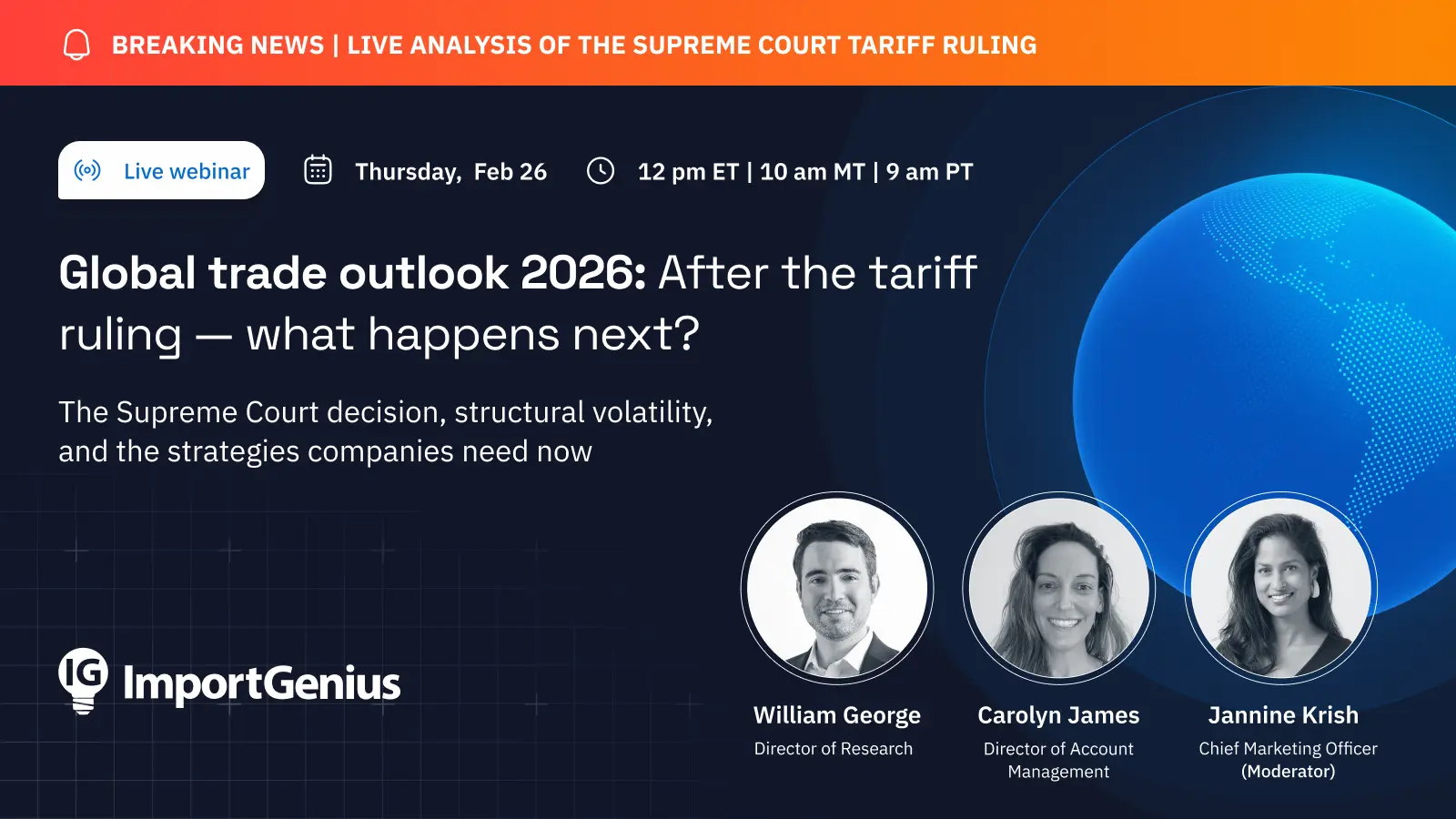
🔴 Updated agenda: Live analysis of the Supreme Court tariff ruling and what it means for importers in 2026.
The Supreme Court decision, structural volatility, and the strategies companies need now
The global trade landscape just shifted. Again.
In a landmark decision, the U.S. Supreme Court struck down key tariffs imposed under the International Emergency Economic Powers Act (IEEPA) — a ruling that could reshape costs, refund claims, sourcing strategy, and competitive dynamics for importers in 2026.
This isn’t a return to stability. It’s the latest signal that trade volatility is now structural — driven not only by tariffs and geopolitics, but by legal reversals, policy pivots, and power fragmentation across global markets.
Join our live briefing to understand what the ruling changes, what it doesn’t, and how supply chain leaders should respond in a year defined by constant disruption.
What we’ll cover
- What the Supreme Court ruling actually means for tariff rates — and potential refund claims
- How to assess your exposure to past and future tariff volatility
- What to expect from the USMCA review in July
- Which countries are gaining U.S. market share as trade power fragments
- Whether imports from China can realistically be replaced — and what that means strategically
- How AI and trade intelligence are transforming supply chain decision-making
We’ll also examine what last year’s trade war actually did to shipment volumes, port activity, and supplier shifts — and how those structural forces will shape the next 12 months.
Why this matters now
Tariffs being overturned does not eliminate volatility. It introduces a new kind:
- Legal uncertainty
- Potential refund litigation
- Rapid policy reversals
- Competitive reshuffling across industries
Who should attend
- Business leaders planning for the year ahead
- Supply chain teams seeking resilience and flexibility
- Logistics executives navigating intensifying competition
- Retailers and importers reassessing sourcing strategy
- Market intelligence professionals monitoring supplier shifts
Some companies may recover significant capital. Others may see new cost pressures emerge under different trade authorities.
The companies that win in 2026 will not be those reacting to headlines, but those reading the underlying trade data in real time.
👉 Discover why trade intelligence is becoming the most reliable leading indicator in global markets.
Featured panelists:




Global trade outlook 2026: After the tariff ruling — what happens next?
Featured panelists:
Transcript
Jannine
Hello everybody. Welcome to our webinar 'Global Trade outlook 2026: after the tariff ruling - what happens next?’ We are just waiting for everyone to arrive and we will get started in a few minutes.
For those just joining, we're just going to give it another 30 seconds or so, and then we're going to get started with our webinar.
All right. Let's get started.
Okay, thank you, everybody, for joining us today. We see a lot of people coming in from all over the world. Canada, USA, China, Indonesia, India, uh, I see some from Latin America as well. Really, from all over, and I really appreciate you making the time to join us live.
Um, for this webinar, which was originally titled Global Trade Outlook 2026, where we were going to talk about our top 3 global trends that we're seeing based on our trade data at Import Genius. Then, of course, the Supreme Court landing. The Supreme Court ruling landed, and we pivoted our content slightly. So appreciate you still staying here. Uh, many of you have so many questions about this, and we're going to save 10 minutes at the end to answer all of your questions, and if we don't get back to you, please email me. You will hear from me right after this webinar. And I will make sure that you get your questions answered.
Um, so despite the ruling, our trends still hold true. Um… you'll all receive, actually, a copy of our Global Trade Outlook report, which is coming out next week, which actually goes into each of these 3 trends in more detail.
The first one being around structural volatility, which you're going to hear more about today. The second one is going to be around trade fragmentation versus the interdependence we're still seeing that our supply chain data reveals. And finally, we're going to briefly touch on the theme of intelligence-led supply chains, and how that actually is a competitive advantage for companies. So at the end of today, we're trying to get you to essentially see the forest from the trees or try to help with that, because there's a lot of murkiness happening that we're hearing about in the media, in boardrooms, across conversations with people at the dinner table, even.
But the three practical questions we want to help answer are what exactly is our exposure? How exposed are we? What… where is trade power actually shifting? And then what capabilities do I need as an importer or exporter now to compete in this landscape?
Now, before we dive in, I would like to take an opportunity to introduce our panelists. So let's start with William.
William
Thank you, Janine. Hi, I'm William George. I'm the director of research here at Import Genius, and I run our media, research, and statistical work.
Jannine
Thank you. And Carolyn.
Carolyn
Hi everyone, great to be here. My name is Carolyn James and I lead our account management and our strategic sales teams here at Import Genius, working directly with our clients and our prospects.
Jannine
Thank you so much for the quick intros. We also have James, who is currently not on screen. Feel free to give a little hi. We're going to go to him after. He's not part of the main panel, but we're going to ask him a question right at the end to touch on that third. Uh, more technology-related topic, as he's the Chief Product and Technology Officer here at Import Genius.
Okay, a little bit of housekeeping before we get started. We're going to spend about 30 to 35 min on our panel today. At the end of that, we will turn it over to you and give you the opportunity to ask questions.Also, everyone that is here today or who registered but didn't have a chance to attend will get the recording of today's webinar, which we'll send out tomorrow.
Okay, now let's get started on the question that everybody is asking. And this question is for you, William, to kick things off.What did the Supreme Court ruling actually change, and what did it not change?
William
Thank you, Janine. So this really is the question that's been on everybody's lips these past few days, because it was earth shaking. On one level, the Supreme Court ruling changed everything. The court's ruling this past Friday was the first time that the Supreme Court has come into direct confrontation, confrontation with the Trump administration over tariff issues, and it clearly established that there was no legal basis for all of the tariffs that Trump has levied under the Emergency Economic Powers Act. Now, a year after…After a year of uncertainty, we really have seen the rubber meet the road here, with the Supreme Court now exercising its constitutionally vested powers and stepping into regulate the executive. So this nullifies all liberation Day tariffs. It nullifies the previous 10% baseline global tariff and the trafficking tariffs imposed on China, Canada, and Mexico.
On another level, though, the fundamental constant of the past year in trade remains, and that is uncertainty and chaos.
The Supreme Court ruling did not provide a clear mechanism for companies to pursue tariff reimbursements. The closing of the de minimis exemption for personal purchases worth under $800 remains in effect, and Trump has doubled down on his commitment to pursue all possible avenues for keeping tariffs in effect. And his first move for maintaining those tariffs has been to threaten a new global rate. This was first 10%, then raised to 15% on Saturday, and now it's actually been imposed down back at 10%. And this is under the authority of Section 122 of the Trade Act of 1974. This is the tariff rate with the 150-day or 5-month limit that we've been hearing so much about, and this is the one that'll take us right up to the midterms.
It's possible that the White House will attempt to suspend and then reinstate the tariffs to restate the clock. This is a move which would undoubtedly be challenged by Congress as well as the court. But he has other mechanisms he can use. Section 301 tariffs, like those imposed on China during Trump's first term and Section 232 tariffs, these are the sectoral tariffs, the ones targeting steel, pharma, furniture. Those remain tools in the tariff arsenal, but they do require lengthy and documented investigative procedures before they can be implemented, which is critical because it gives supply chains and companies time to prepare. Where this leaves us now, though, is in turmoil. Companies are desperate to reclaim tariff refunds. Consumers who've been bearing the burden of increased prices, estimated at $1,700 a household, are wondering where their share will be. $175 billion have been collected but returning it will be far more complicated than the collecting process, which was actually no walk in the park either. And just this week, FedEx has already filed suit requesting a full refund, joining companies who've already filed and many who are sure to follow.
Jannine
Thanks, William. That gives us a sense of what's changed legally. And I know a few people have been following this very, very closely. Uh, let's move it to an operator's perspective, because the question that comes up is, like.
In this landscape where tariffs can be struck down at lightning bolt speed and then replaced within days, how are businesses supposed to actually plan?
William
So, speaking of the lightning bolt speed thing, that's been at core aspect of Trump's tariff policy so far, the sudden imposition and disappearance of tariffs. So in a certain way, the Supreme Court's definition ruling is actually a continuation of that. But at a higher level, I think businesses should understand that we're not out of the woods yet. So when Trump was campaigning, and as he was preparing to take office, he made it very clear that he was going to impose global 10 to 15% tariffs. When he actually began imposing tariffs his IEPA pronouncements were shocking to many supply chain practitioners because they were so far above what he'd campaigned on, especially the China rates. And the tariffs that were proposed then, which when he was campaigning, which we basically have right now these are still a significant tax on US businesses. So basically, we're back to November of 2024 situation in terms of tariff burden.
But companies were able to prepare by front-loading and warehousing in the hopes that they'd be able to bring enough goods in to prevent passing the prices of tariffs deeper into supply chains and on to consumers. Where we are now is that sort of the ideal end goal of front housing and front loading and warehousing.
Because the tariffs are illegal. But instead of celebration and a huge rush to get new goods in, though for some highly tariffed above 15% countries, we may still see that. We're now clearly just in it for the long haul. For the next 5 months, and quite possibly the remainder of Trump's term we're going to be at a 10 to 15% base tariff rate if he has anything to say about it. There are unlikely to be gaps in this or further front loading opportunities. If they appear, you should definitely take advantage of them, but expect to be paying 10% or more on all imports depending on sector.
Jannine
Hmm. Well, we've talked a lot about the legal mechanisms and forward risk. Let's now anchor this in actual evidence and turn it over to the data that we've been seeing. And the shifts in import volumes in 2025. Can you tell us a little bit about how companies that are based on our data, um, how they reacted to tariff uncertainty?
William
Yeah, certainly, and I'm going to do that by sharing a slide here, which is actually taken directly from the, the material that we're providing to you at the end of this webinar. So 2026 is just beginning, and it is already shaping up to be a distinctly different year in trade from 2025.
But 2025 is still the ideal year to look back on to explore how companies, ports and various trade lens were affected by deep tariff uncertainty. So in that way, 2025 is still our best guide because this is unprecedented in US history.
So, something to take into account is how dynamic companies are able to be when they are provided with room to maneuver. And we can see that very clearly here in this year-over-year USTU import data. So you'll notice the front-loading spike in January and February, that surge in the line. That was the result of bulk orders that were placed immediately after Trump won in November of 24. I mean, that's that's a three month, three and a half month amount of time between getting the information and rapidly responding and committing significant capital to front-loading. So companies really are able to scramble when they have to, and there's a lot of flexibility there. They just have to provide it with the opportunity to do so. And we see this also in the summer, where LA and Long Beach hit all-time highs, and that was so significant that you can actually see it in the spike during the summer of 25 here on the chart. That was also companies reacting, this time to the sort of opening in the clouds on tariff rates on China, where they were lowered from prohibitive to possible.
The benefit of working with U.S. Maritime trade data is that we can really see this happening in real time with daily TEU volumes visible. It was clear within a week that LA and Long Beach were headed for a record summer.
That inbound freight is already on the water, so there's not much hope when it comes to rerouting around the ports from a carrier perspective or a freight forwarder perspective. But if you're handling inbound container logistics after the ports. Uh, maybe you're in trucking, you're in rail, or you're in third party deconsolidation. At that point, you have another early indicator to ramp up operations for the next month or two.
Jannine
Thank you. So we can see how companies reacted when they had the room to maneuver. But a lot of teams aren't actually looking at TEU charts that often.
Um, they're stuck in the day-to-day operations of trying to forecast, price and plan in real time. So let's take an operational shift here, and I'm going to pose a question to you, Carolyn.
Um, how should companies rethink forecasting when cost structures can change mid-cycle?
Carolyn
Well, you know, Williams touched on some of the changes that companies have been able to achieve, things like stockpiling some shifts in countries of origin. But the reality is the past year has really shown us that supply chains are not that flexible, and they're in many ways very fixed.
Despite the efforts of the Trump administration to, one, reduce U.S. Dependence on foreign imports and two, reshore manufacturing, neither of those have really come to pass. And in fact, what we've seen is the trade deficit in physical goods has reached a record high.
Although, again, the tariffs did lead to some shifts in which countries were trading with the US. It did not reduce the total US imports of these physical goods. And on reshoring, we continue to see job losses, not job growth in the manufacturing sector, to the tune of 80,000 jobs lost in 2025.
On reshoring, we've also been reminded by business leaders and foreign leaders alike, brokering deals with Trump, that while they can make commitments to reshore and invest, these projects take years to come online and are riddled with challenges from obtaining necessary permits for construction to local resistance, to a lack of skilled US labor to employ at these factories.
Other reasons for caution if you look at the demand side, the US Economy continues to grow, and consumption continues to increase. But we are seeing signs of weakening demand that come with a K-shaped economy, something that's been a bit of buzz in the news lately. The idea of the K-shaped economy being that one segment of the economy grows. In this case, high income earners due to stock market gains and asset inflation, while the other side declines with stagnating wages, high housing costs, and inflation of consumer goods, including staple items that are reducing the spending power of the lower and the middle class.This is yet another reason for businesses to have caution.
And lastly, I'll point out that we see the same outsized performance by a select few in our stock market as well. While the stock market, again, has grown and made incredible gains in 2025, touted by the Trump administration, nearly all of these gains are in AI and big tech. Just seven stocks, the Magnificent Seven. And again, to put this in context, when the S&P 500 broke 6,900, a record high for the first time in 2025, nearly 80% of the stocks in the S&P 500 actually closed down and in the red on that very same day.
The point being that you know this this success is not spread evenly across the industries, and industries that are affected by tariffs and inflation have taken really big hits. Consumer staples sector in particular has underperformed in the market. These games belong to just a few. So what does this mean for business? Business that isn't tech or AI? Well, short of trying to capitalize on AI excitement and maybe adding .ai to your company name in hopes of raising your stock price, the thing is really to stay steady and cautious. The winners are survivors. Those that have strong balance sheets and can best mitigate uncertainty and increasing costs. The big companies that have the cash and the ear of administration are most likely to survive.
Jannine
Hmm. So not everyone is feeling the brunt of this equally as we know.Question, William, does it still make sense to get ahead of tariffs by preemptively or by by pre-importing and stockpiling?
William
No, so pre-importing and stockpiling is over. There's one exception, though, and that would be if you are in an industry that is impacted by current or future Section 232 investigations. That connects back to my first point, where if you know that you're about to have your sector slammed with uncertain new tariff rates, you won't know what the rates are, but you know that they're coming that is the time to start bringing goods in. This is going to be a lot less dramatic in terms of overall logistical impact, though, because it's so segmented. So we'll see a much lower logistical footprint and impact with the port chaos that we've seen previously, because it's sector by sector.
Also, industries like pharmaceuticals are very reliant on air freight. So that will also ease the burden a lot when it comes to ports like LA and Long Beach, which could otherwise be clogged with Chinese furniture imports or large bulk goods coming in from Southeast Asia. So there's going to be a lot less stress on that maritime port infrastructure when sectors begin to stockpile.
Jannine
Okay, so stockpiling isn't the answer. Let's bring this back to execution.What are… this one is for Carolyn. What are the… what's the biggest mistakes that companies are currently making?
Carolyn
I mean, it's really tough out there right now for companies. I think the biggest mistake a company can make right now is just not being informed, which is a tall order these days. It's really critical to stay on top of news, market conditions, your own supply chain and data. Complexity has increased tremendously, whether that is staying on top of all of these tariff changes and political news. Staying on top of deadlines to file for refunds and lawsuits and keeping up with these changes all require resources and add a burden to small businesses in particular.
Something to think about also is that companies may need to bring in additional resources to address these challenges. This is going to be the refunds in particular are going to be as cumbersome a process as possible, and deadlines are likely to be important. The amount of paperwork and processing is likely to be outside of the scope of normal business, so I would really urge everyone to make sure you have a good handle on what kind of resources you will need. And be able to plan accordingly.
William
One quick additional point there is, you could. You could estimate your potential tariff refund, and then look to some fraction of that to staff additional headcount for accounting or tariff refund processing.
Jannine
That's a good point. Thank you. Now we've talked a lot about what companies should be doing. I do want to take a moment to turn it over to audience to see what's happening. So I have a quick poll for you, which I'm just going to launch in a second. There we go. You should see it now. Has the recent tariff ruling prompted your organization to reassess sourcing or pricing strategies?Would love to hear your thoughts on this, or to get your thoughts on this. Still seeing some answers coming in. I'm going to share the results. So please take a moment.Okay. Let's share the results so far, bit of everything. Thanks for taking the time. That's helpful context.
Uh, let's zoom out. I'm going to stop sharing that. The ruling disrupted tariff mechanics. And it didn't change global production realities, however. So William, let's get into the nitty-gritty of maritime data and talk about China's share decline. What does it not show? What does it show?
William
Sure thing. I'm gonna go back to the material that we're going to be sharing here. One more slide for you all little sneak peek. And also, I'm glad to see the results of the poll that so many people are focused on this and actively monitoring the situation. So this, this table here is an indication of what we've seen through a TU-based analysis of US maritime trade imports. And this is looking at all US global trade and the share of that trade that different companies have countries have held year over year, 24 to 25. And if we look at this, we can see that in the past year alone, China's share of global US imports has dropped roughly 4%. And that amounts to a little over a million TUs, which if you think about that in terms of vessel capacity. That's a lot of boats. So, if you look at the data for the other countries in the region, you can see directly below China here, in the teal, we have Vietnam, India, and Thailand. Those are all stepping up to fill in the gap that has been left by trade rerouting around China. It's important, though, to note that this is going to be maritime only, so it does not account for the vast majority of Chinese e-tailer activity like Shein or Timu, who are moving goods in. Largely by air freight, though we have noticed a number of Temu imports via maritime under various, various different corporate identities. But China's share of US maritime imports is clearly declining, and this is a continuation of a year over year trend. Though the tariffs have clearly accelerated this and had an impact.
To me, though, the real question here is how much of this actually indicates a shift of productive capacity out of China and into these trading partners, into Vietnam, into India or Thailand. This recent ruling with the Supreme Court shows that there are tremendous risks associated with the investment of significant capital and time into building out new manufacturing capacity in order to align with what is a mercurial and legally questionable U.S. Trade policy.
Something else that we noticed is that the average dollar value of a given TEU imported into the US from China has dropped dramatically. In fact, it's fallen around 40% from December to the summer of this year, which is how far our analysis is extended. Which is staggering about $30,000 to around $17,000. We're getting more precise figures on that.
While part of this may be due to the lower dollar impact of tariffs on cheaper goods, the lower perceived cost. There is another factor of this which has been reported by Bloomberg, both in the summer and also a couple of days ago, 2 days ago, and that's the rise of Chinese logistics companies who are working their ways towards fraudulently declaring values in order to find an unfair way to compete with customers and competitors who are actually paying the tariffs. Because if you imagine that the Chinese shipper receives the full value of the goods, declares to customs a lower value, and then their customer pays a lower value of tariff. That effectively allows them to sell their goods at a lower cost to consumer than those who are engaging in trade under fair practices.
And while this does lower the tariff burden for those customers, it raises a lot of questions about tariff refunds. Will there be an extra level of scrutiny applied now that there's a second chance to catch fraud? I think that's quite likely, and this could also have a chilling effect on the Tariff Refund activity that the Trump administration is maybe counting on to suppress refund claims.
To zoom over across from the Pacific to the Atlantic, though, if we look at Europe, which has had its own bout of tariff whiplash recently with the Greenland discussion, Europe is quite likely to benefit from the confiscation of Trump's IEPA powers. But with a highly advanced manufacturing economy, they're ripe targets for Section 232 sectoral tariffs, and will be substantially impacted by almost any implementation of the proposed pharma tariffs when that investigation concludes. That easily impacts over $115 billion dollars a year of trade between the US and Europe, and will also likely have a knock-on effect on US healthcare costs.
So if we look at the recent US Customs trade statistics calculated by value overall US Imports of goods from China are down about 30% year over year. US exports to China fell as well when China retaliated against the Trump admin's policies. And this is particularly visible in the agriculture sector. But even giving this, the US trade goods deficit fell to $202 billion. This is while still an enormous number, the smallest it's been in over 20 years, and the first time ever that we've had a smaller deficit with China than with the EU.
But I'm looking at these numbers, and I'm looking at the TU thing, and I'm thinking that there's a puzzle here that's sticking in my mind. So when we look at the drop in US imports from China of maritime T use, which is 1.1 million again, in contrast, with the drop in dollars of US containerized maritime import value from China, which is down roughly 27% in that precise category, it just doesn't seem like these things are tracking. And… considering the precipitous drop in TU value, there's a picture emerging here which raises serious questions about the actual accuracy of the data that Customs is collecting and reporting as far as the trade value in dollars is concerned concerned. It seems like with the tariffs we've actually created perverse incentives against correctly reporting trade to customs, and these may have resulted in a substantial undervaluing of our actual trade with China. So we should be taking the recent GDP figures with a bit of a grain of salt as more investigations happen here and Bloomberg two days ago reported that potentially $150 billion more trade from China to the US entered the US than has been actually reported and factored into the US's numbers. So we're going to have to have a lot more investigation here because this impacts air freight just as much as maritime. We may be seeing substantial swing and adjustment of our most serious top-level financial figures.
Jannine
That's a staggering number, and really what you've said, you know, enlightens us on the the risk that we're really misreading the scale of this change.
Let's widen the lens for a moment. Even with the tariffs and with the ruling, China, we all know, remains central to global manufacturing.So Carolyn, I'd like to turn it over to you around this topic. So, with the new order in place, what is really the net impact for China? And before you answer that, I just want to remind everybody to pop your questions in the Q&A, and we're going to get to them in about 10 10 minutes or so.
Carolyn
Yeah, I mean, I think it's even with what William's saying around maybe the US is still actually importing a lot of things from China, it's no surprise China remains a manufacturing powerhouse. It has for decades with excess capacity. It also struggles with weak domestic consumption, a real estate bubble, weak currency, where foreign imports are relatively more expensive for Chinese consumers. And, you know, despite Trump's tariffs and the US attempt to pull away from China, China has continued to dramatically increase its trade surplus away from the United States to other countries. But again, to put numbers around this, in 2025, China's trade surplus grew to $1.2 trillion. The largest trade surplus on record. No other country has had a larger surplus in modern history.
And again, to put some context around this, China's current trade surplus is five times what Japan's trade surplus was with the world in the 1980s in today's dollars. And at the time, in the 80s, that surplus with Japan caused a huge amount of panic in the US, and this is literally five times that size. So, uh, it's really quite staggering, and I think it really points to the fact that China will continue to find foreign buyers and make foreign investments along the Silk Road and other places, because it really needs the export market to prop up its economy. However little or however much the US is going to play a role in that.
Jannine
Yes, it's pretty clear. China is going to keep exporting no matter what. What does the specter of trade deals without the US mean for the future?
Carolyn
Yeah, I mean, we've seen a lot of activity in trade with China and with other countries. The fallout of sort of the instability of the United States and the more…uh… combative approach we've taken to global trade. We've seen companies, or countries, rather, make deals. Um, China recently updated and expanded the China ASEAN Free Trade Area, or CAFTA, in October 2025, further expanding trade there. Um, just in January, we've seen China and Canada finalize a trade deal that cuts tariffs on EVs and canola oil and also probably most notably India and the EU signed a free trade deal in January of 2026, a deal that covers nearly 2 billion people and slashes tariffs between those countries.
All that being said, though the US isn't really making many deals, it is certainly doing business and doing a lot of trade. So despite the tariffs, the US trade deficit in goods has hit a record high. and the US continues to import more than it ever has from all over the world.
William
Yeah, and the idea that has sort of underpinned this tariff policy is the idea of reshoring and bringing back everything under American business. So everything from extraction to manufacturing, basically a full vertical reintegration of the US and while these things take time, we're clearly not rebuilding on this capacity. We're investing in rare earth mining, which is an important step, but that's going to take many years to pay off dividends, and we are not effectively ramping up any significant industry, uh, or doing much building in the country at the moment, aside from a massive buildout of AI data center infrastructure. So we'll need to see a lot of movement before we could potentially benefit from .. for American manufacturing. And even setting aside the fact that we're not currently building out this capacity. There's also no way that these goods will ever be price competitive with the Chinese or Southeast Asian manufacturing prices that over the past 20 years US consumers have come to know and love. For example, a couple months ago, Wedbush analyst Dan Ives made a lot of waves with a calculation that a 100% made in America iPhone would cost around $3,500. And this would not be an isolated issue. This would extend to similar cheap staples like televisions and refrigerators, which would likely 3 to 4x in price. So we might have a return to the idea of the refrigerator as a status symbol in our future.
Jannine
That's a scary thought. If imports from China can't be fully replaced, Carolyn, what should companies realistically be doing?
Carolyn
Well, you know, again, I think the point here is China is a manufacturing powerhouse. It's continuing to do a lot of business around the world and with the US and on the side of the US, You know the US is the world's largest consumer market in terms of spending power. And there really is no evidence despite a lot of intent from the Trump administration to sort of change the dynamics. The rest of the world can't really fill the gap in manufacturing or the gap in spending, which inevitably entries the US and China together.
And the point I think to really make of the last year is that these trade wars have really hurt the people and the businesses of these countries, China and the US. Recently, the New York Times reported on the duality we see in Ningbo, China, which is the world's busiest container port and a city with a population of nearly 10 million people. All exports continue to hum, margins have collapsed on these exports. Automation has taken over jobs to combat these falling margins. There's been falling asset prices, particularly in the asset, uh, in the housing market. That's really destroyed middle class wealth and eaten into consumer spending power. Unemployment is high, government spending, which is reliant on real estate prices, has collapsed. And the domestic activity in this very, very busy halt has basically ground to a halt.
In the US, you know, we also see suffering. American companies and consumers have footed the bill for these tariffs, and we see some of our sectors have taken really big hits, most notably American farmers. Um, and those who sold soybeans to China. Again, to put some numbers around this, the USDA Foreign Agricultural Service shows a 76% drop in bulk soybean exports to China. That is trade that went from 12.6 billion dollars in 2024 to just 1.3 billion in 2025.
On top of this, the USDA is projecting that the 2025 soybean crop will be the most expensive soybean crop ever grown on a per acre basis, leaving soybean farmers with their third straight year of significant losses. We're seeing the effect of this. US farm bankruptcies have spiked by 46% in 2025, and we expect that we're going to continue to see these bankruptcies due to high prices and a lack of foreign buyers.
The point in all of this being that these tariffs really have been punishing to many people and businesses in both countries, and the US and China really will have to continue to figure out how to work together.
William
And just to quickly follow up on that point, if we look at American farming, we can see that, though it doesn't seem like it as almost an import export business, because they're hit by tariffs on both ends. All of their inputs, machinery, fertilizer, everything they're using to plant and maintain their fields, that's getting more expensive. And on the other side, they're also having a harder time selling their crop. So they're really caught in the crosshairs here in an awful way.
Carolyn
Yeah, that's a really good point, William.
Jannine
Hmm. So going back, you know, to the interdependence that we discussed. We see the pressure doesn't disappear. One of the most immediate pressure points is in North America.William, what should we expect from the upcoming USMCA review?
William
So the USMCA review is going to be a moment where Trump gets to assert his new vision for trade for North America, and there's a significant irony in the fact that Trump, who proposed the USMCA in 2019 as an update to NAFTA which he characterized as a very bad trade deal. Trump is now being blocked by USMCA, his own, um… trade deal from levying the tariffs that he wants to levy on Mexico and Canada. So I think that the thing to look for here is going to be a restructured or a totally blocked deal that allows Trump the freedom to broadly impose tariffs on our two closest trading partners. Under that section 122, Trump's ability to rapidly impose variable tariff rates has been restricted, right? And that's part of the reason why we discovered that he was only going to levy the 10%, not the 15% that he threatened, because he was locked into a max 10% global rate by trade deals that he made with foreign trading partners before the IEPA powers were taken away from him.
So he's now going to have to tighten his focus because he's lost the operational flexibility in tariffing that's given him the ability to impose inconsistent rates. So with this smaller scope of focus because he's now going to have to be using alternate tools, some that haven't been tested, some that require lengthy investigative processes. He's likely going to be focusing on China, Mexico, and Canada, which are the focus of his trafficking tariffs previously and have been… really the countries that he's been cracking down on most aggressively in his rhetoric and in terms of his activities in the past year.
Jannine
So there's clearly more turbulence ahead. But there's also risk in environments. But here's the risk. Um, companies can overreact just as much as they can underreact, as we've seen. So what's the danger, William, in over… rotating sourcing decisions.
William
So, as Carolyn pointed out earlier, a big discovery has really been that supply chains are deeply inflexible. So I think the most important takeaway really is that you need to focus on what works and not the best possible solution. If you have a supply chain that can handle the volume that you need, and that allows you to remain competitive. That's fantastic. That's a really great place to be in several years when things hopefully settle out, then you can start implementing improvements, and you have the time to begin considering those improvements now.
But, at the moment, and for the next year or 2, I think you should just keep in mind that good enough is great.
Jannine
I like that quote. Good enough is great. But might I add only if you have the visibility to know what good enough actually is. Which brings me to our next poll. I would love to just get a pulse check from the audience. Give me a moment. I hope you can all see this now. So how confident are you in your ability to detect supply chain risk before it impacts cost or availability. If you could take a moment to answer that question.
All right. Let me end the poll and share the results.
Well, there's definitely companies that are still operating reactively which is exactly why we are seeing the rise of intelligence-led supply chains. So I know we're really reaching the end of our time here. But James, please turn on your camera before we actually head into our Q&A to close things out. I did want to ask you, um, so a question around this, not just from a trade perspective, but from a technology and capability perspective. For those who didn't hear it in the beginning, James is our chief product and technology officer here at Import Genius, and he's been leading our work at the intersection of AI, trade intelligence, and supply chain decision making. James, thank you for joining us for this one last question. Okay. Oh. Yeah.
James
Sure thing, Jannine. Thank you. It's a big question. And I, you know, for my slot into these webinar. I threw together some some quick thoughts to summarize what's a fairly large topic, but… Structurally, what I see is a big change for our users is the time horizon. More volatility means that we're moving from one end of the spectrum, which is macro year level strategic planning, daily status quo operations to the other end, which takes us closer to war room style of quick decision making. And this movement of the industry is becoming more like a school of fish, you know, darting one way and then another in response to changing situations, at least to the extent that there is flexibility in execution. You know, as Carolyn mentioned. Supply chains in aggregate aren't that nimble. We saw in the 1st poll today that 30% of our attendees have made significant strategic adjustments, and and the rest are trailing right? Not ready to make a dramatic move. We're not able. And this all creates new demands for data and tools. As the head of product at Import Genius, I find that our clients are more concerned about data freshness than before. Data sources that can update as often as daily can become more valuable in this environment. And on the tooling side, this means the ability to do analysis and find insights faster.
So as much as off-the-shelf products like ours can provide powerful and user-friendly access to analytics, new AI tools also give you the ability to run complex ad hoc analysis. So, for example, I can go into our Import Genius product and I can quickly work up analytical views like zeroing in on a port or segmenting by country of origin or breaking down by TEUs. And this is quick, extremely practical, can be very useful and productive. But then I might have more specific question, the kind that general purpose data tools haven't been built for something nuanced and specific to my situation, my industry, my business. These are the kinds of analytical challenges that Import Genius's research department often takes on.
But for this level is assuming that you don't have data analysts on staff. I highly recommend that you get familiar with the new AI tools. Get an anthropic pro subscription, install Claude Cowork, which is the most user friendly cutting edge tool that I know of. Use the new Opus 4.6 model, dump out 10,000 row query from Import Genius or from any other data source that you work with, and tell it to sniff out a challenging question for you, especially for companies that don't otherwise have these capabilities.
I suspect you'll be astounded by what these new models can do, and within minutes, creating interactive results that even if you've tried this already, the tech has moved forward significantly, even just in January. And the capabilities just keep accelerating. My extra advice to someone who's new to this topic is to resist the urge to purchase off the shelf analytical packages that tout AI features and instead work directly with the frontier models like Anthropics, Claude Opus, or OpenAI's new codecs. The gap between recent technology and the current cutting edge is just staggering, and it's remained true, especially over the last 12 months. So you want to be right at ground zero when the new capabilities ship. Even cutting edge vendors like Databricks or Snowflake. They necessarily lag behind on this step with their BI features.
Yeah, so that wraps up my advice for today. Hope this was helpful.
Jannine
Thank you so much, James. I'm sure that was very helpful for many of our our listeners today. We do have a number of questions that have come in, and I'd like to start with one from Steve. What is… he's asking about the trade data from Mexico and Canada into the USA. And what do these numbers look like? Does Import Genius only use maritime data? Perhaps I can. I'll throw this out to any of you, because I know any of you could answer this question.
William
Yeah, I'm happy to start here. So for the US, we only have access to maritime import data, but we have access to fantastic data from Mexico, which covers all modes of transportation. And that goes really into detail and even allows you to identify things like, value added through import-export activity, manufacturing modification to goods. So there's a lot of work that can be done there for what we've been working on here. We've been very focused on US maritime trade activity that's been the the key focus, for our research department, as we've been assembling stats for the global trade outlook, but we do often work with data for other countries, and we're totally happy to talk to you or advise you on how to do that, as well as speak at length about the many virtues of the Mexican trade data, because we've gotten this in the past, a year and a half or so, and we're deeply excited about it.
Unfortunately for Canada, Canada does not make their data public, but you can actually still see some portion of Canada's maritime imports that pass that are on ships that pass through US vessels or US stopping vessels en route to Canada, because freight remaining on board is declared. So you can see a lot of Vancouver's imports, for example.
Thank you.
Carolyn
Yeah, and I'll just add to that and say that the data that Import Genius provides to users is very granular and is really transactional, and that is this US maritime data and the Mexican trade data. I think it's also important to make the point, we referenced a number of these statistics in our… in our global trade outlook, and we have in this webinar. There is also data that lives in the public realm that is US Census data that describes global trade at large and goes into a lot of detail on Mexico and Canada trade, just not at the bill of lading level. Um, so you're able to see that visibility, and some of that has been referenced here today in this webinar, and is also referenced in the Global Trade Outlook.
William
Right, and the joy of this granular data is that you can zoom in from that top-level statistical data and identify which specific companies in which sectors are impacted and to what degree.
Jannine
Okay, next question. Why? This one is from Mike. Why is the narrative around tariff refunds saying that it is going to be so complicated? We have every CBP entry recorded by tariff category, as most companies do, I suspect so when the Supreme Court ruled, it took literally 15 minutes to get our refund number by entry. We could provide all information to the federal government within days.
William
So in an ideal environment, this would be as quick and easy a process as you described there. But if we look to Trump's announcement this past Friday, he initially said this would be litigated in the courts over years, and then updated that to say 5 years. And there are a couple of techniques that might allow him to make this more difficult than it would be. I mean, first of all, the Trump administration is strongly incentivized not to return this 175 billion dollars. So they're looking for any excuse to slow this down and prevent it from happening, and one that they've already indicated that they're going to be exploring is trying to get companies to prove that they did not pass the tariff burden on to consumers. So the idea being that companies could hypothetically profit from raising prices in accordance with tariffs, and then also get a tariff refund, which… While a reasonable argument is going to delay things.
Jannine
Thank you. We are getting a lot of very specific. Oh, sorry. Go ahead.
Carolyn
I'm sorry. Just just to add on this, just to end to the point that William made earlier in this webinar about this potential fraud and underpayment of tariffs, all of this is further compliment complicating that argument, and kind of points to the idea that this is going to get potentially can get very tricky very quickly.
Jannine
Thank you. I just wanted to to say we are also getting a lot of very, very specific tariff related questions. Import Genius is not an expert on this particular area, but I do want to provide them an insert so that you know where to go in case you don't.
Wiliam
And you mean tariff refunds specifically since yes, since we're not customs brokers and and we're not lawyers. Sorry, I meant terrify, but specifically.
Jannine
So we're… where should they go? To their custom brokers and lawyers?
William
Carolyn, I think you had some thoughts about this.
Carolyn
Yeah, I mean, I think the best thing really to do is to speak with your customs broker, or if you have customs in-house, those folks are really going to be your your experts. There are some companies that have sort of free tariff calculators, um, and certainly going into your ACE portal can help you estimate those things, but really, um, you know, you should talk to the experts, and those experts are the customs brokers themselves.
Jannine
Thank you so much. We are really out of time. We're, in fact, 2 minutes over. So what I'm going to suggest is please share your… questions with me. You're going to get the recording tomorrow, and you can respond directly if you have questions that we can answer. We will get back to you.
I wanted to take a moment. Oh, actually, sorry, I know I forgot to let William speak to one other question that came up earlier in the in the in the webinar, and I'll get back to it. William, the 338 question.
Okay.
William
Yes, this was asked by by Daniel in the audience. So the idea of Section 338 of Smoot-Hawley being used to escalate after 122 and I think that's totally possible. If there's anything that we've seen from Trump's strategy as far as imposing tariffs. It's that he likes to escalate and then sort of hit an inflection point, crisis point, and then cut down. And this drives a lot of attention, and it drives a lot of concern from US trading partners that can be leveraged potentially into beneficial trade deals to the US. So, I would be totally unsurprised if we see that. Though, the thing is, like AEPA, this is a totally untested power, and this is really a delegated congressional, but this is a congressional power delegated to the president. So there's a lot of potential legal challenge against this, just as IPA was challenged, very similar arguments could be brought against this.
Though, the most exciting sort of nuclear option here is that 338 can accelerate into a full trade embargo, and Trump did mention trade embargoes during his Friday speech so this is likely on his mind.
Jannine
Thank you so much. I am just reverting to the last closing slide. Just want to take a moment to thank all of you for joining us for our esteemed panelists, William, Carolyn, and James. I know a lot of work went into preparing for this. I really appreciate your time.
One last thing for those of you, um… who have more questions or really want to talk to the team, we've got a whole bunch of trade specialists and experts here to help. Feel free to book time with us. You can find us a link on our website under the book a demo form, it’s right up there on the top importgenius.com.
And then I'd also like to remind you that every one of you that was here today or registered is going to receive our Global Trade Outlook 2026 for free. We are sharing this next week, and much of our presentation came from here as well.
With that, I'd like to close it out and wish you all a wonderful rest of the week. Thanks again. Bye.
