

Bill of lading database: search US shipments by company, product or port
Look up any US importer or overseas supplier and see every shipment on record: who they trade with, what they ship, which ports and carriers they use, and how their volumes change over time. ImportGenius holds 300M+ US import bills of lading from U.S. Customs and Border Protection (CBP) vessel manifests, 2006 to present, plus 8B+ shipment records from 25+ countries.

What is bill of lading data?
A bill of lading (BOL) is the document a carrier issues for every shipment it accepts. It acts as the receipt for the cargo and names the shipper, the consignee and the goods. When a vessel arrives in the United States, the carrier files its manifest, built from these bills of lading, with U.S. Customs and Border Protection (CBP). That manifest data is what a bill of lading database collects and makes searchable.
Each record shows the shipper (the overseas supplier), the consignee (the US importer) and the notify party, with their addresses, plus the product description, weight, quantity, container count, vessel, voyage, carrier, and the ports of lading and unlading. Across millions of shipments, these records show who really supplies whom. That is the evidence compliance, sourcing and sales teams use to verify a company before they trust it.


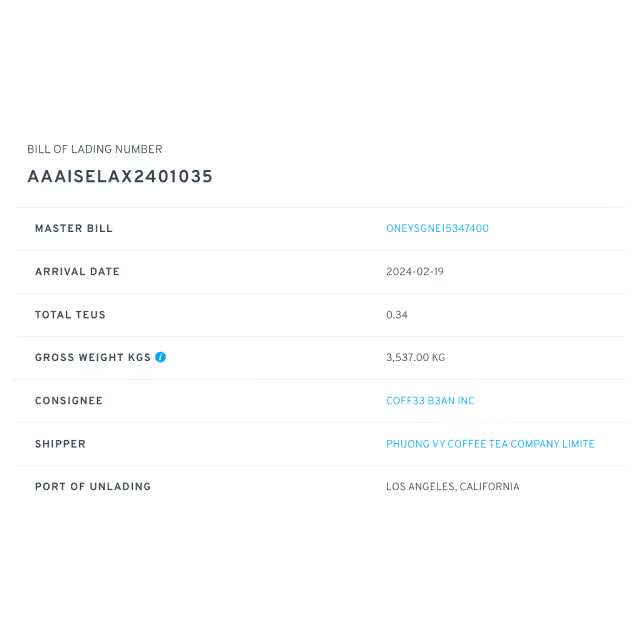

What you can do with the ImportGenius bill of lading database

Search bills of lading by company name: importer, consignee, shipper or notify party
Search by product description, HS code, port, vessel or bill number
Open full records with cargo descriptions, weights, quantities and container details
Verify a supplier or buyer with names and addresses on both sides of each shipment
See tier 1-3 supplier connections mapped automatically
Follow port-to-port lanes, vessels, voyages and carriers over time
Estimate volumes with AI-calculated TEUs when container data is missing
How to search bills of lading with ImportGenius
ImportGenius collects bills of lading from U.S. Customs and other customs sources, cleans and standardizes every field, and groups the different spellings of a company name under one company, so a search returns the whole shipment history.

Search by company, product or port
Look up bills of lading by shipper, consignee, notify party, product, HS code, vessel, port or bill number, and combine filters.

Open detailed BoL records
See the cargo description, weight, quantity, container count, addresses of both parties, vessel and voyage.

Map the supply chain
See a company's suppliers, its suppliers' suppliers and its customers (tier 1-3), mapped automatically from its bills of lading.

Access enhanced analytics
Use shipment counts and AI-estimated TEUs to benchmark a company against its competitors or track a supplier's activity month by month.
Coverage includes millions of U.S. import BoLs (2006–present) plus select international Bills of Lading. TEU calculations are AI-generated when explicit container details are missing.

Who benefits most from this feature


If you’re not looking at the BoL, you’re guessing, not verifying
Supply chains hinge on accuracy. Bills of Lading are the most detailed shipment records available, offering the visibility required for compliance, sourcing, and competitive intelligence. With ImportGenius, you can access verified BoLs, map multi-tier relationships, and use AI-enhanced volume metrics to make confident decisions based on real data—not assumptions.
Unlock complete visibility with detailed Bills of Lading
Search, verify, and map shipments using the most comprehensive BoL database available.


Frequently asked questions
US records come from the vessel manifests carriers file with U.S. Customs and Border Protection (CBP) for every ocean shipment into the US. CBP makes this manifest data public under 19 CFR 103.31, which is how providers like ImportGenius can offer it. Records for other countries come from their customs declarations and shipment data. ImportGenius cleans each record, standardizes the fields and links company names so you can search them.
Yes. Search any importer, consignee, shipper or notify party, or search by product, HS code, port, vessel or bill number. ImportGenius groups the different spellings of a company's name, so you see its full shipment history, suppliers and customers in one place. If a company doesn't appear, it usually requested manifest confidentiality with CBP, ships by air or truck (those manifests aren't public), uses a freight forwarder or customs broker as the consignee, or trades under another legal name. Searching its known suppliers or products usually finds it.
Government sources such as USITC DataWeb publish free trade statistics, but by product and country, not by company. Some sites offer free, limited US import lookups. ImportGenius Tradebase profiles show a free summary of a company's recent shipments; full bill of lading records, filters and exports come with a plan.
Shipper and consignee names and addresses, notify party, product description, HS code, weight, quantity, container numbers and count, vessel name, voyage number, carrier, port of lading, port of unlading and arrival date. Values and prices are not included. When container details are incomplete, TEU values are estimated using AI models trained on historical and commodity-specific patterns.
US import bills of lading go back to 2006 and are updated. A record appears once the carrier's manifest is filed with customs, so ImportGenius shows shipment history, not a shipment's live location.