Pakistan Import & Export Data
Unlock strategic trade intelligence on Pakistan — pivotal hub between China, the Middle East, and South Asia
Gain visibility into Asia-Pakistan trade flows, identify regional suppliers, find new customers, and monitor your competitors across this high-growth geopolitical corridor.

More available data
Foreign currency
Unit Price
Importer ID
Shipping Bill Date
IGM Date
Quantity and unit
As South Asia’s strategic trade corridor, Pakistan plays a critical role in global commerce. It connects China to the Arabian Sea through CPEC, supports multi-modal transport routes, and anchors regional trade across South and Central Asia.
Connects China, South Asia, and the Middle East via the China–Pakistan Economic Corridor (CPEC) and Gwadar Port on the Arabian Sea.
Over 251 million consumers with growing demand despite inflationary pressures and recovery from investor uncertainty.
Energy infrastructure and logistics development under CPEC drive regional connectivity and support emerging industrial supply chains.
At a glance
Pakistan trade snapshot
Population: 251 M
GDP (PPP): USD 376.5 billion
Trade blocs: ECOTA | TPS-OIC | D-8 PTA | MPCEPA | SAFTA | PSFTA | IP-PTA | PM-PTA | CPFTA | TIFA | UZ-PTA
Top exports: Rice, men’s cotton ensembles, cotton bed linen, terry towels and linen, textile bed linen
Ports covered: Karachi Port, Port Muhammad Bin Qasim, Gwadar Port, Keti Bander, Pasni Port

Trade bloc footprint
ECOTA
TPS-OIC
D-8 PTA
MPCEPA
SAFTA
PSFTA
IP-PTA
PM-PTA
CPFTA
TIFA
UZ-PTA
What drives (and challenges) Pakistan’s trade
Major industries
Energy and fuels
Strong import flows of petroleum and natural gas sustain domestic demand.
Textiles and garments
Cotton-based exports anchor Pakistan’s manufacturing sector.
Agriculture
Rice remains a key export and rural economic driver.
Emerging risks
Political instability
Leadership changes and unrest have shaken investor confidence.
Economic volatility
High inflation and interest rates heighten default risk.
Security tensions
Cross-border attacks and regional conflict pressure trade stability.
Major ports & infrastructure

Karachi Port (Sindh)
Pakistan's busiest port handling 60% of national shipments with 65.25M tons and 1.56M TEUs annually, featuring 41 berths across 32km of wharves with 16m anchorage depth and 75,000 DWT capacity.
Port Muhammad Bin Qasim (Sindh)
Second-largest port processing 35% of maritime trade with 16.6M tons and 700,000 TEUs yearly, connected to industrial zones spanning 12,220 acres and handling vessels up to 75,000 DWT.
Gwadar Port (Balochistan)
Strategic deep-sea port near Straits of Hormuz with current capacity of 30M TEUs, planned expansion to 400M tons by 2045, supporting vessels up to 440,000 DWT as China-Pakistan Economic Corridor hub.
Keti Bander (Thatta District)
Historic fishing harbor on Indus River serving as regional hub for Arabian Sea catches, supplying fresh seafood to Karachi for processing and international export, located 4 hours from Karachi.
Pasni Port (Balochistan)
Medium seaport and fishing harbor on Makran Coast with modern processing facilities, exporting primarily to Karachi and Turbat, connected via National Highways and Pasni Airport.

How ImportGenius helps with Pakistan trade data
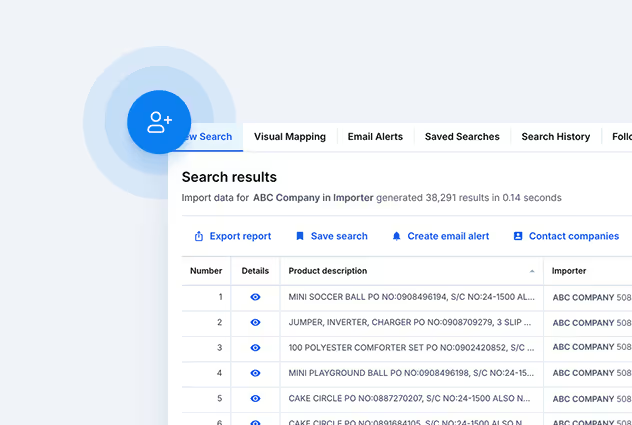
ImportGenius provides direct access to Pakistan customs declarations and regularly updated shipment data.
Competitive intelligence
Track competitors’ suppliers, products, and market entries.


Supplier discovery & vetting
Identify and validate qualified suppliers in Pakistan.
Supply chain visibility & risk management
Monitor policy, compliance, and disruption risks.


Market intelligence & sizing
Analyze HS code trade flows to forecast opportunities.
Data available for the following countries
Search global import and export records from Asia, Europe and Latin America
Asia
Latin America
Turn Pakistan’s trade data into your next growth strategy.
ImportGenius provides direct access to Pakistan customs declarations and regularly updated shipment data.